
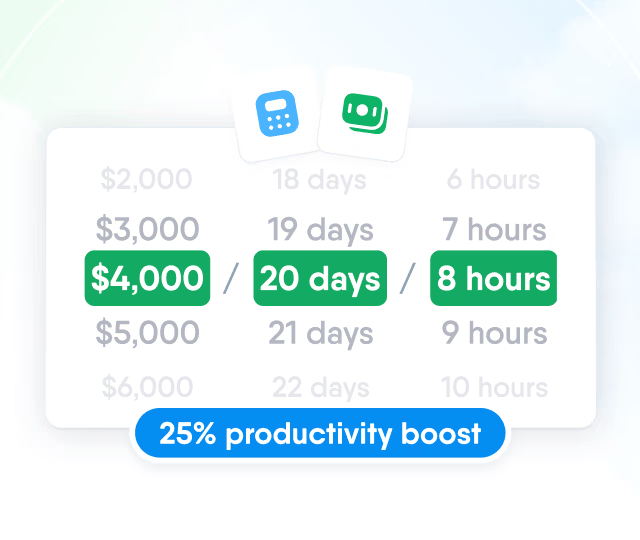
HR efficiency estimator
How does the HR efficiency estimator from PeopleForce work.
Calculate your impact



Employment contract
What an employment contract is, what it must include, the main contract types, how written requirements differ by country, and how HR creates, signs and stores contracts without paperwork
An employment contract (also called an employment agreement or contract of employment) is a legally binding agreement between an employer and an employee that defines the terms of the working relationship: the role, pay, working hours, place of work, leave, confidentiality obligations and how either side can end the relationship. It exists whether or not anything is signed, since accepting a job offer and starting work already creates a contract, but a written version is what protects both parties when expectations diverge, and in most countries outside the United States a written document or written statement of terms is required by law.
What an employment contract includes
- Parties and start date. The legal names of the employer entity and the employee, the start date and, where relevant, the end date or the event that ends a fixed-term contract.
- Role and duties. The job title, reporting line and a summary of responsibilities, often by reference to the job description, plus the place of work and whether remote or hybrid work is permitted.
- Compensation. Base salary or hourly rate, pay frequency, overtime rules, bonuses and commission schemes and the benefits the employee is entitled to.
- Working time and leave. Contracted hours, schedule or flexibility arrangements, annual leave entitlement, sick leave and public holidays.
- Probation. The length of the probationary period, how performance is assessed and the shorter notice that applies during it.
- Termination. The notice period each side must give, grounds for summary dismissal, severance terms and what happens to unused leave and company property.
- Restrictive covenants. Confidentiality, intellectual property assignment and, where enforceable, non-compete and non-solicitation clauses. These are often signed as separate documents such as an NDA.
- Policies incorporated by reference. Many contracts point to the employee handbook, code of conduct and disciplinary procedure rather than restating them.
Types of employment contracts
Permanent (indefinite) contracts have no end date and are the default in most jurisdictions: if a contract does not say otherwise, courts usually treat it as indefinite. Fixed-term contracts end on a set date or when a project or replacement cover finishes; many countries limit how many times they can be renewed or how long they can run before they convert into permanent employment. Part-time contracts set fewer hours than the company standard and, in the EU, must give pro rata the same rights as full-time roles. Casual, zero-hours or on-call contracts guarantee no minimum hours and are typical for seasonal or event work. Internship and apprenticeship contracts combine work with training and often follow special rules on pay and duration. Separately, an independent contractor agreement is not an employment contract at all: it is a commercial services agreement, and misclassifying an employee as a contractor is one of the most common and expensive compliance mistakes.
Written, verbal and implied contracts by country
In the United States most employment is at will and no written contract is required; written agreements are common for executives, sales roles with commission plans and anyone bound by restrictive covenants, while offer letters and handbooks fill the gap for everyone else. In the European Union the Transparent and Predictable Working Conditions Directive (2019/1152) requires employers to give every worker the essential terms in writing, most of them within the first seven days. In the United Kingdom a written statement of particulars is due on or before the first day. In Poland the contract must be concluded in writing, and if it is not, the employer must confirm the terms in writing before the employee starts work; Ukraine requires a written contract in defined cases and a written hiring order for everyone, and the employee cannot start before the employer notifies the tax authority. In Argentina the contract is presumed indefinite and can be verbal, but registration with the authorities is mandatory and unregistered employment carries heavy penalties. The practical rule for HR: treat the written contract as mandatory everywhere, because labor law will fill any gap with defaults that favor the employee.
Changing and ending an employment contract
A contract can only be changed by agreement. Salary increases, promotions, changes of hours or a move to remote work are documented in an amendment or addendum signed by both parties, and in many countries a unilateral change of essential terms gives the employee grounds to claim constructive dismissal. A contract ends by expiry of a fixed term, resignation, dismissal with notice, summary dismissal for gross misconduct, mutual agreement or redundancy, and each route has its own notice, documentation and payment rules; the termination letter should reference the contract clause it relies on. Keeping every version of the contract, every addendum and the signed acknowledgements of policies in one place is what makes a dispute defensible years later, which is why contract storage is a core part of HR document management.
Employment contracts in PeopleForce
In PeopleForce Core HR a contract starts as a document template with variables for the employee, position, department, legal entity and its director, so HR generates a ready-to-sign contract, addendum or hiring order from the employee profile instead of copying data by hand. The document is sent for electronic signature directly from the platform, including qualified electronic signatures where local law requires them, and the signed file lands in the employee's document folder with its status visible to HR. Work types, hire date, probation end date and base compensation are stored as structured fields with effective dates, so the system reminds the manager when probation ends, keeps the history of every salary change and lets an onboarding workflow collect the new hire's details, generate the contract and request the signature before day one.


Let us show you what's possible
From Core HR to advanced workforce analytics — see the platform saving 80 hours a month for teams just like yours. Fully tailored to your workflow.