
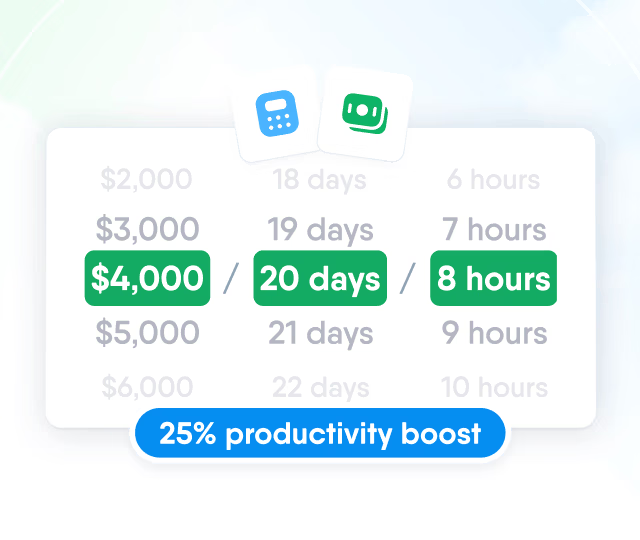
HR efficiency estimator
How does the HR efficiency estimator from PeopleForce work.
Calculate your impact



Reskilling
Reskilling is training an employee to do a different job inside the same company, rather than replacing them when the role they were hired for stops being needed.
Reskilling is teaching an employee to do a different job from the one they were hired for. The trigger is usually structural: a product line closes, a process gets automated, a market shifts, and a group of people with real institutional knowledge are suddenly holding skills the company no longer needs. Reskilling is the decision to keep the people and change the skills, instead of making the role redundant and hiring the new capability from outside.
That framing matters, because reskilling is often sold as a benefit and it is really a workforce planning decision. It competes directly with hiring, and it should be evaluated the same way: cost, time to productivity, and the probability that it works.
Reskilling vs upskilling
The two words get used interchangeably and they describe different moves. Upskilling goes deeper into the job someone already does: a support specialist who learns SQL is still a support specialist, just a better one. Reskilling changes the job itself: that same support specialist becoming a data analyst is reskilling, and their title, manager and success criteria all change with it.
Practically, upskilling is continuous and low-risk, and reskilling is a project with a start, a budget and a real chance of failure. A company that says it has a reskilling strategy but only runs optional courses has an upskilling program, which is fine as long as nobody is relying on it to close a structural skills gap.
When reskilling beats hiring
Reskilling wins when the scarce ingredient is context rather than technique. Someone who has spent four years in your operations team knows your customers, your edge cases and why the obvious fix was tried and abandoned in 2023. That is slower to acquire than most technical skills, and an external hire will spend months rebuilding it. It also wins when the target skill is teachable in months rather than years, when there are enough transferable skills to build on, and when the alternative is a redundancy process with its own severance cost and reputational damage.
It loses when the gap is a genuine profession rather than a skill, when the business needs the capability this quarter, or when the person does not actually want the new job. The last one is the most common failure and the easiest to ignore, because employees rarely decline a program that is presented as an investment in them.
How a reskilling program is actually built
The work happens before any training is bought. It starts with workforce planning: which roles are shrinking, which are growing, and what the overlap between them looks like at the level of actual tasks rather than job titles. A training needs analysis then turns that overlap into a specific list of what has to be learned.
- Define the target role in competencies, not in a job ad. Competency mapping is what makes the distance between the current role and the target role measurable.
- Select on aptitude and motivation, not on tenure or sympathy. Reskilling places offered as consolation to the people most affected by a restructure have the worst completion rates.
- Pair learning with real work. Courses alone transfer badly. Job shadowing, a live project in the target team and a mentor inside it do more than the curriculum does.
- Protect the time. If the training sits on top of a full workload, it is unpaid overtime with a nicer name and it will be the first thing dropped.
- Guarantee the destination. People will not commit six months to a program that ends with an invitation to apply through internal recruitment like any external candidate.
Why reskilling programs fail
Most of them fail quietly, and the pattern is consistent. The program is announced at a company level with a large number attached and no named target roles, so nobody can tell whether it worked. Completion is measured instead of placement, and completion is easy. The training is generic because generic is cheaper, which means the graduate has a certificate and no portfolio. And the receiving manager, who was never consulted, prefers to hire someone who has done the job before. That last one kills more programs than any curriculum decision, which is why the hiring manager belongs in the design conversation, not in the announcement.
The measure that survives scrutiny is simple: how many people ended up doing the new job twelve months later, and how their performance compares to external hires into the same role. Everything else, including hours of training delivered, is activity rather than outcome.
Running reskilling in PeopleForce
The part companies underestimate is the bookkeeping: knowing who has which skills, at what level, and who assessed that. In PeoplePerform competencies are objects you define once and then reuse inside review templates, so a review question can be tied to a specific competency rather than to free text. Each competency in a review cycle carries a weight, the weights across a cycle have to total 100, and the resulting scores render as a radar chart with one series per reviewer group. That gives you a before and after picture per competency for anyone in a reskilling track, and it is the same instrument you use for everyone else, so the comparison to peers in the target role is direct.
The learning side sits in courses built from sections, with participants tracked per course and organised by category and tag. Assignment does not have to be manual: a course can be attached as an action inside a workflow, alongside tasks, forms and one to one meetings, so a change of department or position can trigger the whole learning path automatically. HR analytics then puts course participation, review scores and actual role changes in the same place, which is the only way to answer the placement question rather than the completion one.


Let us show you what's possible
From Core HR to advanced workforce analytics — see the platform saving 80 hours a month for teams just like yours. Fully tailored to your workflow.