
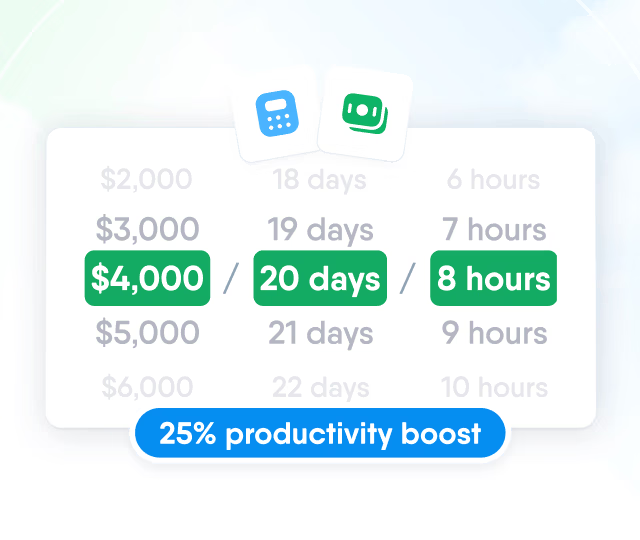
HR efficiency estimator
How does the HR efficiency estimator from PeopleForce work.
Calculate your impact



Span of control
How many people report directly to one manager. How to calculate it, what moves the right number, and what breaks at each extreme.
Span of control is the number of people who report directly to one manager. It is the single number that decides how many management layers a company needs: a company of 300 people with an average span of five needs far more managers, and one more layer of hierarchy, than the same company with an average span of ten.
How to calculate span of control
For an individual manager, span of control is simply the count of their direct reports. People further down the branch are indirect reports and belong to a different measure, the depth of the structure rather than the width of one role.
For a company, the usual formula is total employees divided by the number of people who manage at least one person. In a company of 240 people with 30 managers, the average span is eight. That average is worth splitting by department before drawing conclusions, because a support team of twenty under one lead and an engineering group of three under another can produce a healthy looking average that describes nobody's actual situation.
Narrow and wide spans
A narrow span, commonly three to five reports, gives each person close attention and works where the work is complex, risky or new. The cost is structural: more managers, more layers, a taller vertical organization, slower decisions because each one travels further, and a standing temptation toward micromanagement when a manager has more attention available than the work requires.
A wide span, roughly ten to fifteen and sometimes higher, flattens the structure, cuts management cost and pushes decisions down to the people doing the work, which supports employee empowerment. It fails in a specific way: the manager becomes an approval bottleneck, one on one meetings get cancelled first, and development conversations quietly disappear because there is no time left for them. Weak performers survive longer under a wide span because nobody has the bandwidth to notice.
What sets the right number
There is no universal figure. The right span moves with the work:
- Complexity and variability of the tasks. Repeatable, standardised work supports a much wider span than judgment heavy work.
- Experience of the team. A group of juniors in their first year cannot be managed at the same span as a team of senior people who need almost no direction.
- How much of the manager's week is non-managerial. A team lead who still delivers their own work half the time cannot carry twelve reports.
- Coordination load between reports. If the reports constantly depend on each other, the manager spends the week resolving interfaces rather than managing people.
- Location and working pattern. Distributed or shift based teams need more deliberate contact time per person than a co-located one.
- Rate of change. During a reorganisation, a new product or a rapid ramp up, the same team needs a narrower span than it will in a stable year.
Span of control and the shape of the organization
Span and layers are two views of the same structure. Widening the average span removes layers; narrowing it adds them. This is why cost reduction programmes so often arrive as a span target: removing a layer of management is the fastest structural saving available, and it is also the change most likely to overload the managers who remain if the target is applied uniformly rather than by function.
The reverse failure is the unplanned span. Teams grow one hire at a time, nobody re-examines the organizational chart, and a lead who started with four people is running seventeen without anyone deciding that. In a matrix organization the count also has to include dotted line reports, since the demand on the manager is real even when the reporting line is not formal. Treating span as an input to workforce planning, rather than an outcome noticed afterwards, is what keeps headcount growth from quietly reshaping the organizational structure.
How PeopleForce makes span of control visible
Span is easy to measure and easy to ignore, because the number only becomes obvious when someone draws the structure. In Core HR the org chart renders in two modes, one built from reporting lines between people and one built from departments, so you can see both the manager level picture and the shape of the company. Each node on the people chart carries a count of the team beneath it, with the total and the direct number separated, which is exactly the distinction that gets blurred when spans are discussed from memory.
Every employee profile shows that person's direct reports, so a span check takes seconds rather than a spreadsheet rebuild. Planned roles live alongside filled ones as positions with a status of vacant, recruiting or filled, which means a manager's span can be evaluated as it will be after the open roles close, not only as it stands today. HR analytics then tracks headcount over time by department and legal entity, so a widening span shows up as a trend rather than as a complaint in a performance review.


Let us show you what's possible
From Core HR to advanced workforce analytics — see the platform saving 80 hours a month for teams just like yours. Fully tailored to your workflow.