
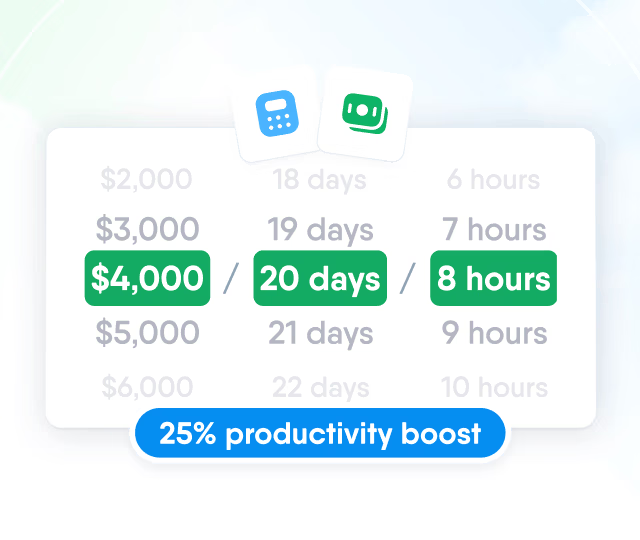
HR efficiency estimator
How does the HR efficiency estimator from PeopleForce work.
Calculate your impact



Organizational structure
What organizational structure is, the elements that define it, the main types from functional to matrix and flat, how to choose and change one, and how to keep the structure live in HR data
Organizational structure is the system that defines how work, authority and communication are arranged in a company: who reports to whom, how people are grouped into teams and departments, where decisions are made and how information moves between units. It is usually visualized as an organizational chart, but the structure is more than the chart: it also includes job levels, spans of control, decision rights and the formal channels through which teams coordinate. A good structure makes the strategy executable; a bad one produces duplicated work, slow decisions and people who are unsure who owns what.
Elements of an organizational structure
- Chain of command. The reporting lines from individual contributors through managers to the executive team, and the number of layers between the two.
- Span of control. How many direct reports a manager has; narrow spans mean more layers, wide spans mean flatter organizations and more autonomous teams.
- Departmentalization. The logic used to group people: by function, product, customer segment, geography or process.
- Centralization. Whether decisions are concentrated at the top or delegated to the teams closest to the work.
- Formalization. How much is governed by written rules, job descriptions and procedures versus judgment.
- Job levels and grades. The classification that ties positions to seniority, pay bands and career paths.
Types of organizational structure
A functional structure groups people by specialty: engineering, sales, finance, HR. It is efficient and builds deep expertise, but departments can become silos that optimize for themselves. A divisional structure creates self-contained units around products, markets or regions, each with its own functions; it moves accountability close to the customer at the cost of duplicated roles. A matrix organization, described in the matrix organization entry, gives people two reporting lines, typically functional and project or product, trading clarity for flexibility. A flat structure minimizes management layers and relies on cross-functional teams, which works well up to a few dozen people and gets harder as headcount grows. A hierarchical or vertical structure has many layers and clear authority at each; it scales predictably but slows decisions. Newer models such as team-of-teams, holacracy and agile organizations built around tribes and squads try to combine the accountability of divisions with the speed of small autonomous teams. Most companies above a certain size are hybrids of several types rather than pure examples of one.
How to choose and change a structure
Structure follows strategy. A company competing on operational efficiency leans functional and centralized; one competing on speed in several markets leans divisional and decentralized. Size matters too: a structure that works at 40 people will not work at 400, and the usual signs that it has stopped working are managers with fifteen direct reports, decisions that need three escalations, and projects that stall because no one owns them end to end. A redesign is a change management project, not a drawing exercise: map current roles and decision rights, define the target state and the reasons for it, model the impact on headcount and cost, communicate what changes for each person, and give the new structure time before judging it. Keeping the structure current afterwards is part of workforce planning: every hire, transfer and departure changes the shape of the organization.
Organizational structure in PeopleForce
In PeopleForce Core HR the structure is not a slide that goes stale but a live view of the employee data. Each employee record holds a position, department, division, location, legal entity and reporting manager, and the org chart is generated from those fields automatically, with a separate departments view for the functional hierarchy. When a manager changes, a team moves or someone is promoted, HR records the change once on the profile with an effective date and the chart, the employee directory, approval routes for leave and requests, and workflow assignees update together. Employees can open any colleague's profile and see where they sit in the organization, which removes the most common question in a growing company. HR analytics reports headcount, turnover and span of control by department, so a structure that has started to strain shows up in the numbers before it shows up in a reorganization.


Let us show you what's possible
From Core HR to advanced workforce analytics — see the platform saving 80 hours a month for teams just like yours. Fully tailored to your workflow.