
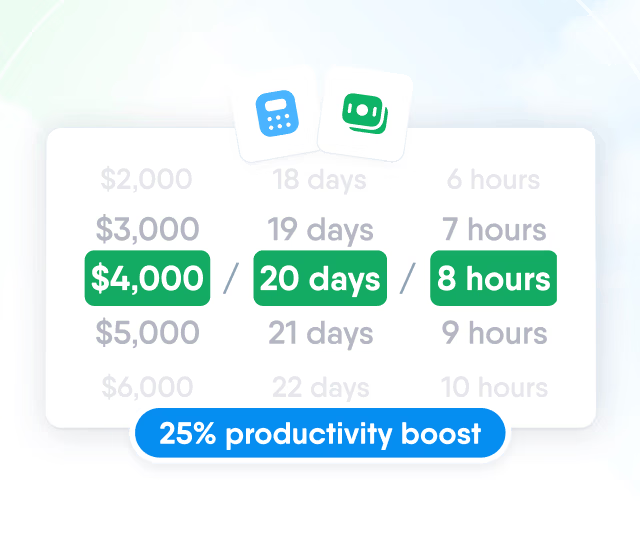
HR efficiency estimator
How does the HR efficiency estimator from PeopleForce work.
Calculate your impact


Change management
What change management is, why change fails, the main models and the process HR can follow
Change management is the structured approach to moving people from the way they work today to the way the organization needs them to work tomorrow. A reorganization, a new HR system, a merger, a shift to hybrid work or a new performance process all change what people do and how they feel about it. Change management is the part of the project that deals with the people side: understanding who is affected, preparing them, supporting them through the transition and making sure the change sticks.
Project management delivers the new structure or tool on time and on budget. Change management makes sure people actually use it. Most failed transformations did not fail on the technical side; they failed because the people who had to change their habits were not brought along.
Why organizational change fails
- No clear reason. People are told what will change but not why, so they fill the gap with the worst explanation.
- Leaders announce and disappear. A single all-hands is treated as communication. Middle managers, who employees actually listen to, are not equipped to answer questions.
- Change fatigue. Several initiatives land at once and none is finished before the next begins, so employees stop investing in any of them.
- No support during the dip. Productivity drops while people learn the new way. If that dip is punished, they revert to the old way.
- Nothing is measured. Without adoption metrics, nobody knows whether the change happened until the next annual survey.
Change management models
Lewin's three stages. Unfreeze the current state (create the case for change), change (move to the new way), refreeze (embed the new way in systems and norms). Simple, and still the backbone of most approaches.
Kotter's eight steps. Create urgency, build a guiding coalition, form a vision, communicate it, remove obstacles, generate short-term wins, consolidate gains, anchor the change in the culture. Useful for large, leadership-driven transformations.
ADKAR. Focuses on the individual: Awareness of the need, Desire to participate, Knowledge of how, Ability to do it, Reinforcement to keep it. Good for diagnosing where a specific team is stuck.
The change curve. Describes the emotional path from shock and denial through frustration to acceptance and commitment. It reminds managers that resistance is a phase, not a character trait.
The change management process
- Define the change and the reason. One paragraph: what is changing, what is not, why now, and what happens if nothing changes. If leadership cannot agree on this paragraph, the change is not ready.
- Map who is affected and how. Different groups lose and gain different things. A new HR system means less paperwork for HR and a new login for everyone else; the message to each has to be different.
- Prepare managers first. Team leads hear the news before their teams, get the talking points and a channel to escalate questions. They are the ones who will be asked "what does this mean for me".
- Communicate repeatedly and in both directions. Announcements, Q&A sessions, a written FAQ that is updated as questions come in. Listen as much as you broadcast: pulse surveys during the rollout show where confusion or resistance is concentrated.
- Train and support. Give people the knowledge and the time to learn, and make the first weeks forgiving. Identify early adopters who can help peers.
- Measure adoption. Usage of the new tool, completion of the new process, engagement scores in affected teams. Define the metric before the launch.
- Reinforce. Update job descriptions, onboarding, review criteria and recognition so the new way is the default and the old way is no longer available. This is where most changes are lost.
HR's role in change management
HR usually owns the people side of any major change and is the change owner for its own initiatives, such as a new performance management system, a compensation redesign or an HRIS migration. That means designing the communication plan, coaching managers, adjusting job descriptions and policies, watching engagement and turnover in affected teams, and running the training that makes the change possible. A strong company culture with open communication makes all of this easier; a culture of blame makes every change harder than it needs to be.
Supporting change in PeopleForce
The communication and feedback loop of a change program runs on tools most HR teams already have. In PeopleForce Core HR, announcements reach every employee with notifications in Slack and the mobile app, and a knowledge base holds the FAQ and updated policies in one place. Workflows assign tasks to managers and employees on a timeline, so a rollout plan becomes a checklist with owners and dates rather than a slide. PeopleForce Pulse runs scheduled anonymous surveys with results segmented by department, location and tenure, which shows where a change is landing badly while there is still time to respond. When the change is a new team structure, effective-dated position and manager changes in the employee profile keep the org chart and reporting lines accurate from day one.


Let us show you what's possible
From Core HR to advanced workforce analytics — see the platform saving 80 hours a month for teams just like yours. Fully tailored to your workflow.