
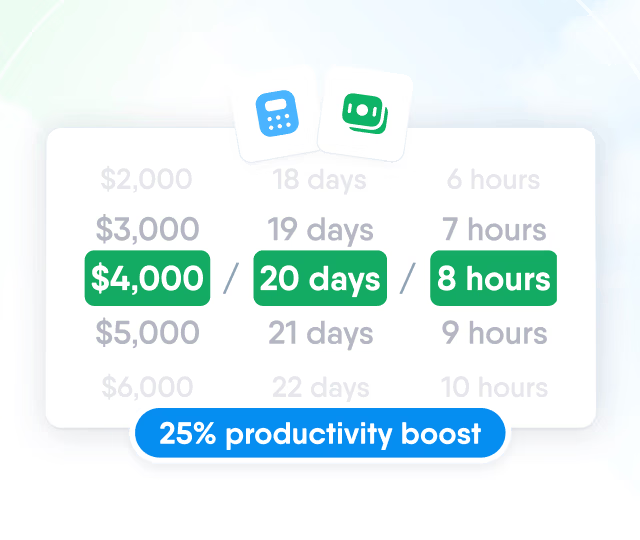
HR efficiency estimator
How does the HR efficiency estimator from PeopleForce work.
Calculate your impact



Pulse Survey
What a pulse survey is, how it differs from an annual engagement survey and how to run one
A pulse survey is a short, frequent employee survey, usually five to ten questions sent every week, two weeks or month, designed to track how people feel about their work over time. Where a full engagement survey takes a detailed photograph once a year, a pulse survey takes a quick reading often enough to see the trend and react before a problem becomes a resignation.
The format borrows from medicine: a pulse check is fast, repeatable and tells you whether something needs closer attention. The value is not in any single result but in the line the results draw over months, broken down by team, location or tenure.
Pulse survey vs. annual engagement survey
- Frequency. Pulse: weekly to monthly. Annual survey: once or twice a year.
- Length. Pulse: five to ten questions, two or three minutes. Annual survey: forty to eighty questions, twenty minutes or more.
- Purpose. Pulse: spot changes and test whether an action worked. Annual survey: measure the full set of engagement drivers in depth and benchmark against other companies.
- Questions. Pulse: a small stable core repeated every time plus one or two rotating items on a current topic. Annual survey: the complete model.
- Response time. Pulse: results within days, action within the same month. Annual survey: results in weeks, action plans that run for a year.
The two are complements, not alternatives. The annual survey tells HR which drivers matter most in this company; the pulse survey shows whether those drivers are moving in the right direction between annual cycles.
What a pulse survey measures
Most pulse programs track a few stable indicators and rotate the rest:
- eNPS. The employee net promoter score, a single question on whether the employee would recommend the company as a place to work, is the most common anchor item.
- Engagement drivers. Statements on workload, manager support, recognition, clarity of goals, growth opportunities and well-being, rated on an agreement scale.
- Topical items. One or two questions about something happening now: a reorganization, a new tool, a return-to-office policy, a recent all-hands.
- An open comment. A free-text field, often the most useful part, where the specific reasons behind a low score appear.
Why companies run pulse surveys
Early warning. A team whose scores drop two months in a row is a retention risk that an annual survey would surface too late. Pulse data lets a manager act while the people are still there.
Feedback on decisions. When a policy changes, the next pulse shows how it landed. This closes the loop between a management decision and its effect on employee experience without waiting a year.
Higher response rates. A two-minute survey gets answered; a twenty-minute one gets postponed. Regular short surveys also normalize giving feedback, which supports a broader feedback culture.
Segment-level insight. Because the same questions repeat, differences between departments, locations or tenure groups become visible and comparable over time, which is where most actionable findings live.
How to run a pulse survey that people keep answering
- Keep it short and predictable. Same day, same length, same core questions. People answer habits, not requests.
- Guarantee anonymity with a minimum group size. Show results only for segments with at least five responses, and say so in the survey itself.
- Ask only what you will act on. A question about the office kitchen is fine if someone will actually fix the kitchen. Otherwise it teaches people that answering changes nothing.
- Share results quickly. A short summary to the whole company and a segment view to each manager within a week of closing.
- Close the loop visibly. Announce what changed because of the last pulse. This single habit does more for response rates than any reminder.
- Watch for fatigue. If response rates fall, reduce frequency rather than adding reminders. Monthly is enough for most companies.
Pulse surveys in PeopleForce
PeopleForce Pulse runs surveys on a schedule, so a pulse goes out automatically at the chosen frequency without HR sending it by hand. Responses are anonymous, and results are shown as agreement scores per question and per driver, with an eNPS view tracked over time. Every survey can be segmented by department, division, location, position, tenure, employment type and other attributes from the employee profile, so a dip in one team is visible without exporting anything. Comments are collected alongside the scores, and HR can finish a survey early or reopen it if a team needs more time. Because Pulse shares its data with Core HR, the segments stay current as people move between teams.


Let us show you what's possible
From Core HR to advanced workforce analytics — see the platform saving 80 hours a month for teams just like yours. Fully tailored to your workflow.