
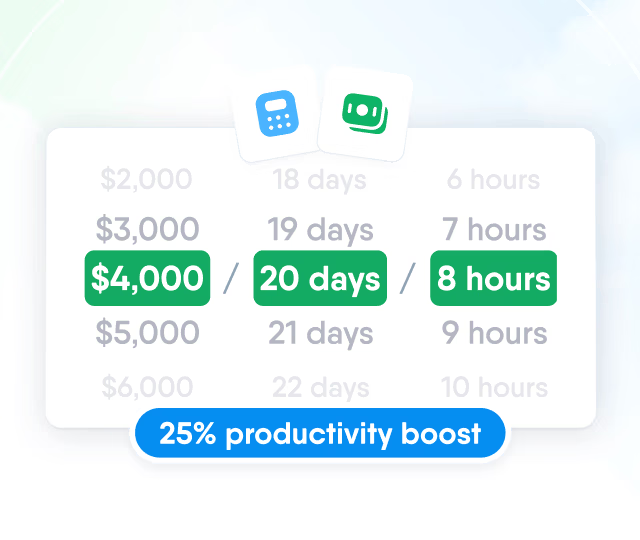
HR efficiency estimator
How does the HR efficiency estimator from PeopleForce work.
Calculate your impact



Employee Engagement Survey
What an engagement survey measures, how it differs from pulse and satisfaction surveys and how to run one
An employee engagement survey is a structured questionnaire that measures how committed, motivated and connected employees feel toward their work, their team and the company. It typically covers the full set of factors known to drive employee engagement, from manager relationships and recognition to career growth and trust in leadership, and is run once or twice a year with the whole workforce.
The survey turns something managers otherwise sense only anecdotally into numbers that can be compared across teams, tracked over years and benchmarked against other companies. It is the diagnostic instrument; the pulse survey is the monitor that runs between diagnoses.
What an engagement survey measures
Most models group questions into a set of drivers and one or two outcome measures:
- Outcome measures. Overall engagement (pride, energy, intention to stay) and usually the employee net promoter score. These show the state; the drivers explain it.
- Manager relationship. Support, fairness, quality of feedback, frequency of one-on-ones.
- Role and workload. Clarity of expectations, autonomy, sustainable workload, tools to do the job.
- Growth. Learning opportunities, career path, whether skills are used.
- Recognition and reward. Feeling valued, fairness of pay, employee recognition practices.
- Team and culture. Collaboration, psychological safety, inclusion, alignment with company values.
- Leadership and direction. Confidence in senior leaders, clarity of strategy, quality of communication.
- Well-being. Stress, work-life balance, support during difficult periods.
Questions are statements rated on a five- or seven-point agreement scale, with a few open-text items for context. Forty to sixty items is typical; beyond eighty, completion rates fall.
Engagement survey vs. satisfaction survey vs. pulse survey
Engagement asks whether people are invested in the work and the company. Satisfaction asks whether they are content with conditions such as pay, office and hours. An employee can be satisfied and disengaged at the same time, which is why modern surveys measure engagement and treat satisfaction items as one driver among several. Pulse surveys use a handful of the same items far more often; they trade depth for frequency and rely on the annual engagement survey to define which items matter.
How to run an engagement survey
- Decide what you will do with the results before you ask. If leadership is not ready to change anything, do not run the survey. An unaddressed survey lowers engagement more than no survey at all.
- Use a tested question set. Write items as clear single statements, avoid leading language and keep the core stable year to year so trends are real.
- Communicate purpose and anonymity. Explain why the survey is happening, how anonymity is protected and when results will be shared. State the minimum group size for reporting.
- Keep the window short. Two weeks is enough. Send two reminders, then close.
- Analyze by segment and by driver. The company average hides everything useful. The findings are in the gaps between departments, locations, tenure groups and managers, and in which drivers correlate most strongly with the outcome measure.
- Share results within a month. A company-wide summary from leadership, plus each manager's team results with a facilitated discussion.
- Commit to two or three actions, not twenty. Pick the drivers with the largest gap and the strongest link to engagement, assign owners and dates, and report progress. Track the effect with pulse surveys until the next full cycle.
Why engagement surveys matter
Engagement predicts the outcomes HR is measured on. Teams with higher engagement scores show lower voluntary turnover, less absenteeism, fewer safety incidents and higher productivity and customer satisfaction, and the survey is the only systematic way to find out where engagement is weak before those outcomes deteriorate. It also gives employees a structured, safe channel to say what is not working, which is itself a driver of engagement when the company visibly listens.
Engagement surveys in PeopleForce
PeopleForce Pulse runs both full engagement surveys and scheduled pulse surveys on the same platform. Questions are grouped by driver, responses are anonymous and results are shown as agreement scores per question and per driver alongside eNPS, so the outcome and its causes sit on one dashboard. Every result can be segmented by department, division, location, position, tenure and employment type using data from Core HR, comments are collected next to the scores, and HR can close a survey early or reopen it. Lifecycle surveys at onboarding, probation and exit add the moments when engagement is most likely to shift.


Let us show you what's possible
From Core HR to advanced workforce analytics — see the platform saving 80 hours a month for teams just like yours. Fully tailored to your workflow.