
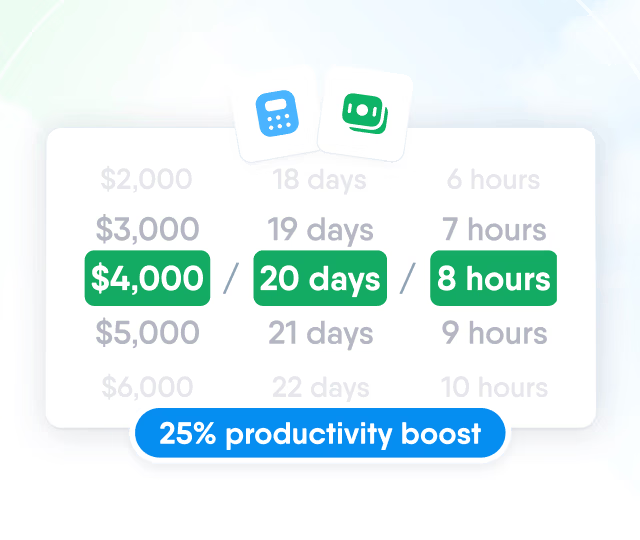
HR efficiency estimator
How does the HR efficiency estimator from PeopleForce work.
Calculate your impact



Company culture
What company culture is made of, why it matters and how HR shapes it
Company culture is the set of shared values, beliefs, norms and behaviors that shape how work gets done in an organization. It shows up in what gets rewarded and what gets tolerated, how decisions are made, how people treat each other under pressure, and what a new hire learns in the first month about "how things really work here". Culture exists whether or not it is written down; the question for HR is whether it is shaped deliberately or left to form on its own.
The written version, a values statement or a culture deck, is only the intended culture. The actual culture is what employees experience day to day. When the two match, the values guide behavior. When they diverge, people trust their experience and treat the statement as decoration.
What company culture is made of
- Values and purpose. What the company says it stands for and why the work matters. Written company values are the reference point; their credibility depends on everything else on this list.
- Leadership behavior. What leaders do, especially under stress, sets the ceiling for everyone else. A value that leaders visibly break is not a value.
- Norms and rituals. How meetings run, how feedback is given, how wins are celebrated, how mistakes are handled, whether people write or talk, how fast replies are expected.
- Systems and incentives. Hiring criteria, promotion rules, performance reviews and pay decide which behaviors get reinforced. Culture follows the incentives, not the poster.
- Communication. How much information is shared, with whom, and how early. Transparency and psychological safety are cultural properties, not communication tactics.
- Physical and digital environment. Office layout, remote or hybrid setup, the tools people use and the etiquette around them.
Why culture matters to the business
Retention and hiring. Culture is a leading reason people stay or leave, and a strong, clearly described culture attracts candidates who fit and filters out those who would not, which lowers turnover and strengthens the employer brand.
Performance. Teams that share norms coordinate faster and need fewer rules. Cultures with high trust and clear accountability consistently show higher engagement and productivity.
Resilience through change. When strategy shifts or a crisis hits, culture is what people fall back on. A culture of open communication absorbs change; a culture of blame amplifies it.
Risk. Most compliance failures and ethics scandals trace back to a culture that rewarded results over conduct. A code of conduct only works inside a culture that takes it seriously.
Types of company culture
The most cited framework describes four types: clan (collaborative, family-like, focused on people), adhocracy (innovative, entrepreneurial, focused on experimentation), market (competitive, results-driven, focused on targets) and hierarchy (structured, process-driven, focused on stability). Real companies mix these, and the useful exercise is not picking a label but noticing where the intended culture and the actual one sit on each axis.
How HR shapes company culture
- Measure the actual culture first. Engagement surveys, exit interviews and onboarding feedback show the gap between stated values and lived experience. Start there, not with a new values poster.
- Hire and promote for the culture you want. Turn values into observable behaviors and assess them in interviews and performance reviews. Who gets promoted is the loudest cultural signal a company sends.
- Design onboarding to transmit culture. The first weeks are when norms are absorbed fastest. Explain not just what to do but why the company does it that way.
- Make recognition specific. Recognize people for the behavior, not just the result, and name the value it demonstrates.
- Hold leaders to the same standard. Upward feedback and 360 reviews for managers make leadership behavior visible and correctable.
- Fix the systems that contradict the values. If the values say "collaboration" but bonuses are purely individual, change the bonus, not the wording.
Supporting culture in PeopleForce
Culture is built through daily practice, and PeopleForce gives that practice a place. In Core HR, announcements and a knowledge base keep values, policies and company news in one space every employee sees, and onboarding workflows deliver them to new hires on a schedule. Kudos let colleagues recognize each other publicly, with notifications in Slack and the mobile app. PeopleForce Pulse measures how the culture actually feels, with anonymous surveys and eNPS segmented by department, location and tenure, so the gap between intended and lived culture is visible team by team. Perform lets companies assess values-based competencies in review cycles, including upward feedback for managers.


Let us show you what's possible
From Core HR to advanced workforce analytics — see the platform saving 80 hours a month for teams just like yours. Fully tailored to your workflow.