
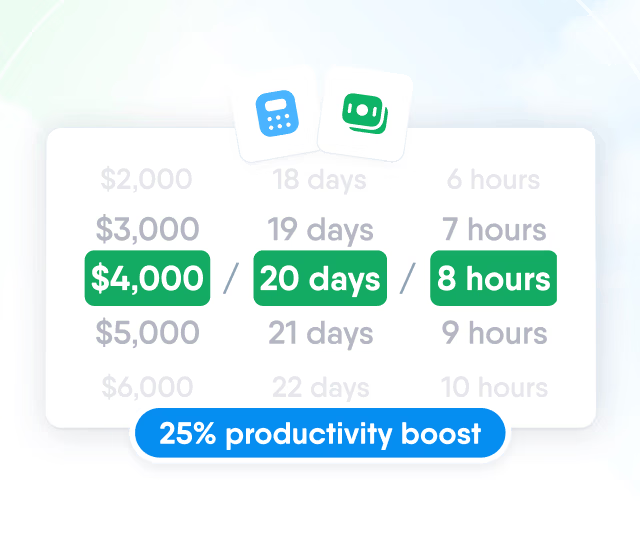
HR efficiency estimator
How does the HR efficiency estimator from PeopleForce work.
Calculate your impact



Psychological safety
Psychological safety is a shared belief within a team that it is safe to speak up, ask questions, admit mistakes, and challenge ideas without fear of embarrassment or punishment.
What is psychological safety?
Psychological safety is the shared belief among team members that they can take interpersonal risks without negative consequences. In practice, it means people feel comfortable raising concerns, asking "naive" questions, admitting errors, and disagreeing with a manager, because they trust the team will respond with curiosity rather than blame.
The term was popularized by Harvard Business School professor Amy Edmondson in her 1999 research on hospital teams, where she found that higher-performing teams reported more mistakes, not fewer, simply because they felt safe enough to talk about them. Google's Project Aristotle later identified psychological safety as the single most important factor distinguishing its most effective teams.
Psychological safety is not the same as comfort or being nice. Teams with high psychological safety often have intense debates. The difference is that the debate is about the work, not about protecting oneself.
Why psychological safety matters for HR
Psychological safety is a leading indicator for many outcomes HR teams already track. When people feel safe to speak up, problems surface earlier, learning accelerates, and employee engagement rises. When they do not, silence becomes the default: mistakes are hidden, innovation stalls, and the risk of employee burnout and quiet quitting increases.
It is also a core ingredient of a healthy feedback culture. Feedback only works when the person receiving it does not feel threatened, and the person giving it does not fear retaliation. The same applies to mental health at work: employees are far more likely to ask for support before reaching a crisis when they trust that doing so is safe.
The four stages of psychological safety
Timothy R. Clark's model describes psychological safety as developing in four stages:
- Inclusion safety. People feel accepted as members of the team and can be themselves.
- Learner safety. People feel safe to ask questions, experiment, and make mistakes while learning.
- Contributor safety. People feel safe to use their skills and contribute ideas without being micromanaged.
- Challenger safety. People feel safe to question the status quo and challenge decisions, including those made by leaders.
Most teams reach the first two stages relatively easily. The real test of psychological safety is whether people are willing to challenge how things are done.
Signs of low psychological safety
Low psychological safety rarely shows up as open conflict. More often it looks like this:
- Meetings where only senior people speak and nobody asks questions.
- Mistakes discovered late, or only after a customer complains.
- Ideas shared privately after the meeting rather than during it.
- Employees agreeing publicly and disagreeing in direct messages.
- Managers who receive very little upward feedback in one-on-one meetings.
- Patterns of micromanagement, blame, or mobbing.
How to build psychological safety in a team
Frame work as learning. Leaders who openly say "we have never done this before, so we will get some things wrong" give the team permission to raise problems.
Model fallibility. When a manager admits their own mistake first, it becomes dramatically easier for others to do the same.
Ask real questions. "What are we missing?" and "What would make you hesitate to ship this?" invite dissent in a way that "Any objections?" does not.
Respond productively. How a leader reacts the first time someone brings bad news determines whether they will hear bad news again.
Make speaking up structural. Regular one-on-ones, retrospectives, anonymous surveys, and continuous feedback loops reduce the personal risk of raising an issue.
How to measure psychological safety
Psychological safety is most commonly measured with short survey items based on Edmondson's original seven-question scale, for example "If you make a mistake on this team, it is often held against you" or "It is safe to take a risk on this team", rated on a Likert scale. Because responses are only honest when they are anonymous, HR teams usually run these questions as part of regular pulse surveys rather than annual reviews.
With PeopleForce Pulse, HR can launch anonymous surveys with psychological safety questions, track the eNPS alongside them, and compare results by team or manager over time. In PeopleForce Perform, peer and upward reviews can be configured so reviewer names stay anonymous to the reviewee's manager, which makes honest feedback about leadership behavior far more likely.
Psychological safety and accountability
A common misconception is that psychological safety lowers standards. Edmondson's framework treats the two as separate axes: teams need both high psychological safety and high accountability. Safety without accountability produces a comfort zone; accountability without safety produces anxiety. High-performing teams sit in the "learning zone", where people are held to demanding standards and feel safe enough to talk openly about how to meet them.


Let us show you what's possible
From Core HR to advanced workforce analytics — see the platform saving 80 hours a month for teams just like yours. Fully tailored to your workflow.