
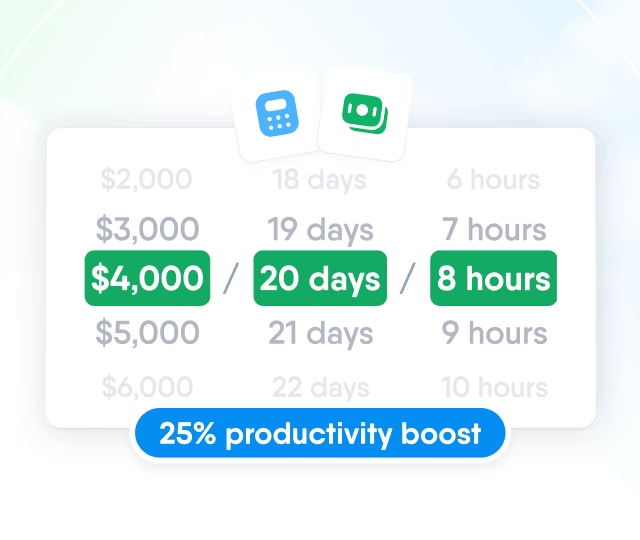
HR efficiency estimator
How does the HR efficiency estimator from PeopleForce work.
Calculate your impact



Succession Planning
What succession planning is, how the process works and the mistakes to avoid
Succession planning is the process of identifying the roles a company cannot afford to leave empty and preparing specific people to step into them when the current holder leaves, is promoted or is suddenly unavailable. It is the part of talent management that turns "who would replace her" from a panicked question into a documented answer.
The term is often associated with CEO transitions, but the same logic applies to any position where a vacancy would stall the business: a lead engineer who alone understands the core system, the only certified accountant, a plant manager, a key account owner. Succession planning covers all of them, at a depth proportional to the risk.
Succession planning vs. replacement planning
Replacement planning is a list: if X leaves, Y takes over tomorrow. It is reactive and covers the emergency case. Succession planning is a development program: it identifies people who could hold a critical role in one to three years, assesses their gaps against the role's competencies and closes those gaps deliberately. Most companies need both, and a good succession plan usually includes an interim name for each critical role alongside the longer-term candidates.
How the succession planning process works
- Identify critical roles. Score positions by business impact if vacant and by how hard they are to fill externally. Roles high on both scales are the succession pool. This is a workforce planning exercise, not an org chart review: some critical roles sit far below the executive level.
- Define what the role requires. Document the core competencies, experience and relationships the role depends on, ideally as a profile that recruiting and performance reviews already use.
- Assess potential successors. Use performance review results, 360-degree feedback and manager judgment to place candidates on a readiness scale such as ready now, ready in one to two years, ready in three or more. A 9-box grid that plots performance against potential is the most common tool for this step.
- Build development plans. For each candidate, list the gaps between where they are and what the role needs, and assign development actions with owners and dates: stretch assignments, job shadowing, mentoring by the current role holder, formal training or a job rotation.
- Review and refresh. Successors leave, roles change and readiness moves. Review the plan at least once a year and whenever a critical role holder announces a departure.
Why succession planning matters
Continuity. The business keeps running through a departure instead of losing months while the vacancy is filled from outside and the newcomer learns the context. This matters most during a notice period, which is rarely long enough to recruit and onboard a replacement.
Retention of high performers. People who know they are being prepared for a bigger role have a concrete reason to stay. Employees who are told nothing tend to assume there is no path and look elsewhere.
Lower hiring cost and risk. Internal successors are cheaper to place than external hires for senior roles and fail less often, because their fit with the culture and their track record are already known.
Knowledge transfer. When a successor is named early, the outgoing role holder has a reason and a counterpart to document and hand over what would otherwise leave with them.
Common mistakes
- Planning only for the top. The CEO has a successor; the person who runs payroll does not. The second gap causes more disruption in practice.
- Confusing performance with potential. The best individual contributor is not automatically the best candidate for the manager's role. The assessment has to test the competencies the next role needs.
- Keeping the plan secret from candidates. If successors do not know they are on the list, the development plan is one-sided and the retention effect is lost.
- Naming one successor per role. A single candidate can leave, decline or stall. Two or three candidates at different readiness levels are safer.
- Never revisiting the plan. A plan from three years ago is a list of people who have since been promoted or have left.
Supporting succession planning in PeopleForce
The inputs for a succession plan already exist in PeopleForce Perform: review cycles score employees against competencies with self, peer, upward and manager input, and the insights view shows how each person is rated across cycles. Competencies are defined once and reused in reviews, so the gap between a candidate's current profile and a target role is visible rather than guessed. Development actions from each review can be tracked as action items in 1:1 meetings, and OKRs give stretch assignments a measurable shape. Position requests in Core HR are built on job profiles, so the requirements for a critical role live in the same place as the people being prepared for it.


Let us show you what's possible
From Core HR to advanced workforce analytics — see the platform saving 80 hours a month for teams just like yours. Fully tailored to your workflow.