
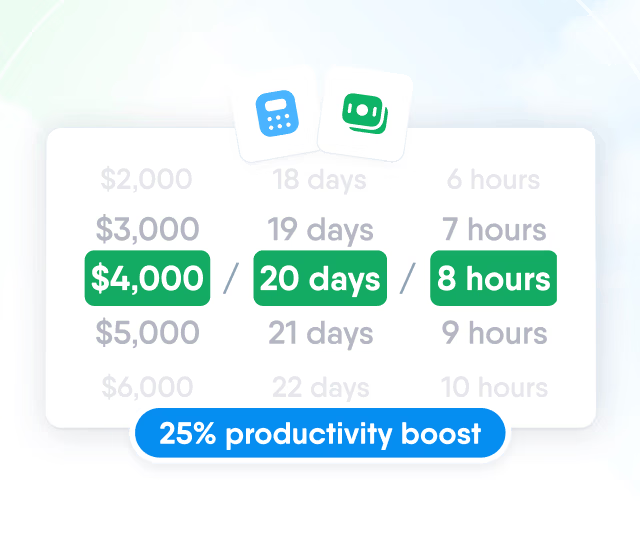
HR efficiency estimator
How does the HR efficiency estimator from PeopleForce work.
Calculate your impact



Job rotation
Job rotation is a planned practice of moving employees between different roles, tasks, or departments for set periods so they build new skills, gain a broader view of the business, and stay engaged.
What is job rotation?
Job rotation is a structured approach in which employees move laterally through a series of positions or task sets, typically for a few weeks to a year each, before returning to their original role or settling into a new one. The moves are planned by HR and managers rather than driven by vacancies, and the goal is development: broader skills, deeper understanding of how the organization works, and a more flexible workforce.
Job rotation sits alongside other job design techniques. Job enrichment adds depth and responsibility to an existing role; job rotation changes the role itself. Job shadowing lets someone observe another role for a short time; rotation puts them in the seat and makes them accountable for the work.
Types of job rotation
Task rotation switches employees between tasks within the same role or team. It is common in manufacturing, logistics, and customer support to reduce repetitive strain and monotony.
Position rotation moves people between distinct roles, often across departments: a marketer spends six months in sales, a product manager rotates through customer success. This is the form most associated with leadership development.
Cross-functional rotation is designed to give employees a whole-business view, and often forms the backbone of graduate and management trainee programs.
Geographic or site rotation moves employees between offices, plants, or countries to spread knowledge and prepare people for regional leadership.
Benefits of job rotation
For employees:
- Faster skill development and more transferable skills.
- A clearer sense of direction on their career path, including lateral moves across a career lattice.
- Less monotony and lower risk of job dissatisfaction and career plateau.
- A wider internal network.
For the organization:
- A bench of people who can cover for absences and fill roles internally, which strengthens internal recruitment and succession.
- Fewer single points of failure and less knowledge concentrated in one person.
- Better collaboration between cross-functional teams, since people understand each other's constraints.
- Higher retention: employees who see growth options inside the company are less likely to look elsewhere.
- A practical way to close a skills gap without external hiring.
Drawbacks to plan for
Every rotation has a productivity dip while the person learns, and the receiving team spends time on training. Some employees prefer depth over breadth and experience rotation as disruption rather than opportunity. Poorly planned rotations can leave the original team short-staffed or send someone into a role they are not equipped for. None of these are reasons not to rotate, but they are reasons to design the program deliberately and make participation voluntary where possible.
How to implement a job rotation program
- Define the objective. Leadership pipeline, cross-training for coverage, retention of high performers, or reducing repetitive strain each call for a different design.
- Map roles and skills. Use a skills matrix and competency mapping to identify which roles are realistic rotation targets and what prerequisites each requires.
- Select participants. Combine manager nominations, performance data, and employee interest. Rotation works best when the employee wants it.
- Set the duration and cadence. Three to six months is typical for position rotation; task rotation can be daily or weekly.
- Prepare the receiving team. Assign a buddy or mentor, define expected outcomes, and agree how the rotating employee's original responsibilities will be covered.
- Track and review. Hold regular one-on-ones during the rotation, collect feedback from both managers, and record the new skills in the employee's profile.
- Close the loop. Decide together whether the employee returns, stays, or moves on, and update their professional development plan accordingly.
Running job rotation in your HRIS
Rotation programs fail administratively before they fail conceptually: nobody knows who is currently where, which manager approves their leave, or what they learned. Keeping the program inside the HR system solves most of that.
In PeopleForce Core HR, each employee has a position history with effective dates, so a rotation is recorded as a new position entry with the temporary department, manager, and location, and the org chart and approval flows update automatically for the duration. PeopleForce Perform lets the host manager set rotation goals, run one-on-ones, and collect feedback at the end, while HR analytics shows how retention and internal mobility compare between employees who rotated and those who did not.
Job rotation examples
A fintech company rotates every new customer support hire through two weeks in compliance and two weeks in product during their first quarter, cutting escalations because agents understand why certain checks exist. A manufacturing plant rotates line operators across three stations every shift to reduce repetitive strain injuries and ensure any station can be staffed on short notice. A consulting firm's two-year analyst program includes four six-month rotations across practice areas before analysts choose a specialization.


Let us show you what's possible
From Core HR to advanced workforce analytics — see the platform saving 80 hours a month for teams just like yours. Fully tailored to your workflow.