
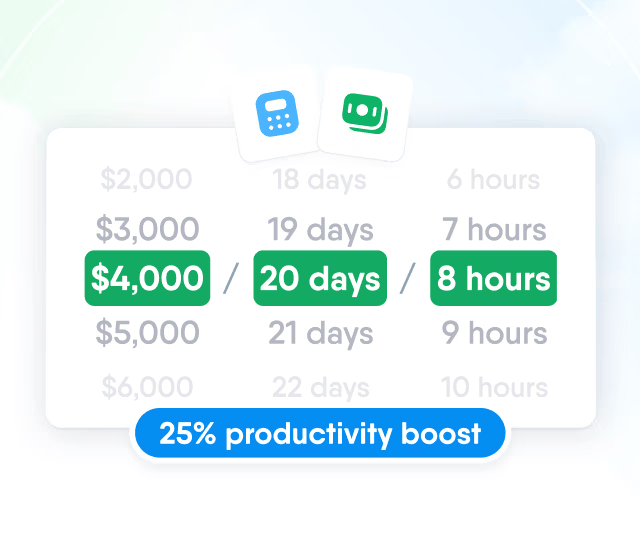
HR efficiency estimator
How does the HR efficiency estimator from PeopleForce work.
Calculate your impact



Total rewards
Total rewards is the complete package an employer offers in exchange for an employee's work: base pay, variable pay, benefits, well-being, recognition, development, and the working experience itself.
What are total rewards?
Total rewards is the full set of monetary and non-monetary things an employer gives employees in return for their time, skills, and results. It goes beyond the paycheck to include everything that makes a job worth having: base salary, bonuses and variable pay, employee benefits, paid time off, learning opportunities, career growth, recognition, flexibility, and the culture people work in.
The concept was formalized by WorldatWork in the early 2000s as a response to a simple observation: candidates compare offers on more than salary, and employees stay for more than money. Treating all of these elements as one deliberate package, rather than a list of unrelated perks, lets a company compete for talent even when it cannot match the highest salary in the market.
Total rewards vs. total compensation
The two terms are often used interchangeably, but they are not the same. Total compensation covers everything with a direct monetary value: salary, bonuses, commissions, equity, employer contributions to insurance and pensions, and allowances. Total rewards adds the elements that have value to the employee but no line on a payslip: development, recognition, well-being, flexibility, and a sense of purpose.
A useful way to remember the difference: total compensation answers "how much does this job pay?", total rewards answers "why would someone choose and keep this job?"
The five components of a total rewards model
- Compensation. Base pay, incentive pay, bonuses, commissions, equity, and the salary bands that structure them.
- Benefits. Health and life insurance, retirement contributions, paid leave, parental leave, and voluntary benefits such as gym memberships or meal allowances.
- Well-being. Mental health support, wellness programs, flexible and hybrid work, and policies that protect people from burnout.
- Development. Learning and development budgets, mentoring, career paths, and internal mobility.
- Recognition. Formal and informal rewards and recognition, from peer kudos to service awards.
Some models add a sixth component, performance management, on the grounds that fair goals and honest feedback are themselves something employees value.
Why a total rewards strategy matters
Salary is the most visible and most expensive lever, but it is rarely the one that decides whether someone stays. Exit interviews consistently point to growth, manager quality, flexibility, and recognition as the reasons people leave, and all of those sit inside total rewards. A deliberate strategy lets HR:
- Compete for candidates without winning every salary auction, by making the full value of the offer visible.
- Spend the budget where it changes behavior, instead of spreading raises evenly.
- Strengthen the employee value proposition with something concrete rather than slogans.
- Improve retention and engagement in a measurable way.
How to build a total rewards strategy
- Inventory what you already offer. Most companies underestimate their package because nobody has listed it in one place.
- Ask employees what they value. Engagement surveys and stay interviews show which elements matter and which are ignored. A benefit nobody uses is a cost, not a reward.
- Benchmark. Use salary benchmarking for the compensation part and market surveys for benefits.
- Align with strategy and culture. A company that wants collaboration should not reward only individual results; a company that hires for growth should fund development visibly.
- Segment where it makes sense. Early-career employees, parents, and senior specialists value different things. Flexible benefit budgets let people choose.
- Communicate the whole picture. A total rewards statement, sent once a year to each employee, shows the full value of salary, bonuses, employer contributions, leave, and development in one document.
- Measure and adjust. Track acceptance rates, turnover, engagement, and benefit usage against cost.
Managing total rewards in an HRIS
A total rewards strategy only works if the data behind it is in one place. Salary in payroll, bonuses in a spreadsheet, benefits with a broker, and training in a separate LMS makes it impossible to see what any one employee actually receives.
In PeopleForce Core HR, each employee profile holds the base salary history with effective dates alongside additional compensation components that the company defines itself: one-off payments such as sign-on or retention bonuses, recurring fixed amounts such as allowances, and recurring variable amounts such as commissions or quarterly bonuses, each with its own start and end date. Salary bands live on job profiles, so every position has a reference range. HR analytics then shows compensation cost by department and legal entity and runs a gender pay gap report, while goals and reviews in PeopleForce Perform supply the performance data that incentive components depend on. With the pieces in one record, producing a total rewards statement becomes an export rather than a project.
Frequently asked questions
What is a total rewards statement?
A personalized document that shows an employee the full monetary value of everything they receive: salary, bonuses, employer-paid insurance and pension contributions, paid leave, training budget, and other benefits. It is usually issued annually.
Is total rewards only relevant for large companies?
No. Smaller companies often benefit most, because they cannot outbid larger competitors on salary and need to make the rest of the package visible.
Who owns total rewards?
In larger organizations a dedicated compensation and benefits team; in smaller ones the Head of People or an HR business partner working with finance.


Let us show you what's possible
From Core HR to advanced workforce analytics — see the platform saving 80 hours a month for teams just like yours. Fully tailored to your workflow.