
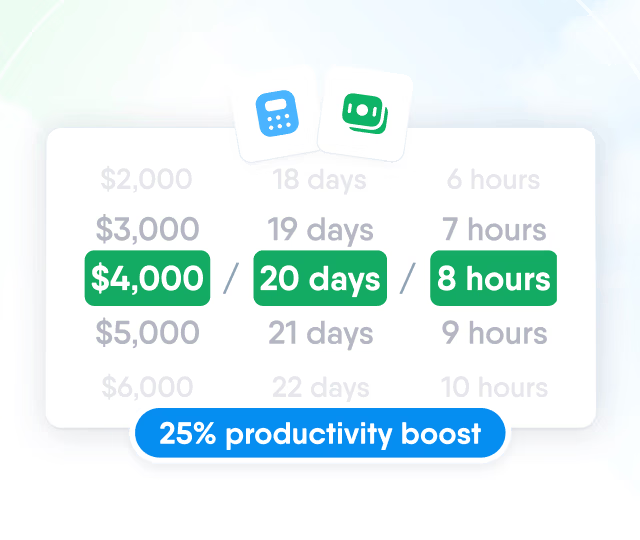
HR efficiency estimator
How does the HR efficiency estimator from PeopleForce work.
Calculate your impact



Learning and development (L&D)
What L&D covers, how it differs from training, and how to build a function that changes performance rather than attendance
Learning and development (L&D) is the HR function responsible for building the knowledge, skills, and behaviours a company needs to reach its goals. It covers everything from the first week of the onboarding process to leadership programmes for senior managers, and it connects individual growth to business strategy: what people learn should follow from where the company is going.
L&D vs. training
Training is an event: a course, a workshop, a certification exam. L&D is the system around those events. It decides which skills matter, who needs them, how they will be developed, and how the company will know it worked. A training catalogue without that system produces attendance, not capability. That is why mature L&D functions start from a training needs analysis and a map of the current skills gap, not from a list of popular courses.
What L&D covers
- Onboarding and role readiness: getting new hires productive in their first weeks.
- Compliance and mandatory training: safety, data protection, anti-harassment, industry regulation.
- Upskilling and reskilling: deepening skills in the current role or building skills for a new one.
- Leadership and management development: preparing first-time managers and future leaders, often tied to succession planning.
- Individual development: mentoring, coaching, job rotations, and individual development plans agreed between an employee and their manager.
Why L&D matters
Development opportunities are consistently one of the strongest drivers of employee engagement and a leading reason people stay or leave. A visible career path supported by real learning improves the employee retention rate, makes internal recruitment possible, and reduces dependence on the external labour market for skills the company could grow itself. For the business, L&D is the mechanism that turns strategy into behaviour: a new product line, a new market, or a new operating model all fail without the skills to execute them.
How to build an L&D function
- Start from business goals. Translate the company's strategy into the capabilities it requires, then compare them with what the workforce has today.
- Define competencies. A shared competency model gives every role a clear target and lets you measure progress in performance reviews rather than by course completions.
- Mix formats. Formal courses matter, but most learning happens on the job and through other people. Combine structured programmes with stretch assignments, mentoring, and manager feedback.
- Give managers a role. Development conversations in one-on-one meetings and clear development plans do more than a catalogue ever will.
- Measure outcomes, not activity. Track competency scores, internal mobility, time to productivity for new hires, and retention of developed employees, alongside completion rates.
L&D metrics worth tracking
Useful metrics include training hours per employee, course completion rate, competency score change between review cycles, share of vacancies filled internally, time to productivity for new hires, and retention of employees who completed development programmes compared with those who did not. Pair them with qualitative signals from pulse surveys and stay interviews to understand whether people feel they are growing.
L&D in PeopleForce
In PeopleForce Perform, development runs alongside performance rather than in a separate tool. HR defines corporate, department, and position-level competencies, uses them in review cycles, and then builds development plans for individuals from templates or from scratch, with action items, owners, and deadlines. Employees get notified when a plan is created, reminded a week before an item is due, and plans are visible in company, team, and personal views, so HR sees coverage across the organisation. Licences and certifications live on the employee profile with expiry alerts, and courses with structured curricula can be assigned automatically through workflows, for example when someone joins a team or changes role.


Let us show you what's possible
From Core HR to advanced workforce analytics — see the platform saving 80 hours a month for teams just like yours. Fully tailored to your workflow.