
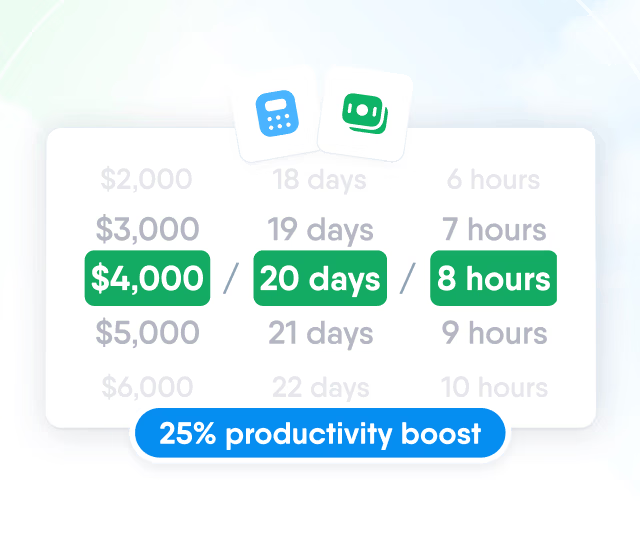
HR efficiency estimator
How does the HR efficiency estimator from PeopleForce work.
Calculate your impact


Organizational development
Organizational development (OD) is a planned, evidence-based approach to improving how an organization works: its structure, culture, processes, and people, so it can adapt and perform better over time.
What is organizational development?
Organizational development (OD) is a systematic, long-term effort to improve an organization's effectiveness and health through planned interventions in its structure, culture, processes, and people. It draws on behavioral science and uses data to diagnose what is holding the organization back, then designs and evaluates changes to fix it.
The field grew out of the work of Kurt Lewin in the 1940s and matured alongside human capital management. Where traditional management focuses on fixing a specific problem, OD asks a broader question: how does this organization need to work differently to succeed in the next three to five years, and how do we get people there?
Organizational development vs. HR vs. change management
The three overlap but are not the same:
- HR manages the employee lifecycle: recruitment, onboarding, compensation, performance, compliance. It is largely operational and continuous.
- Change management guides people through a specific, defined change, such as a new system or a restructuring. It has a start and an end.
- Organizational development sits above both. It looks at the whole system, identifies what needs to change, and shapes the HR strategy and change initiatives needed to get there.
In many mid-sized companies, OD is not a separate department. It is a set of responsibilities carried by an HR business partner, a Head of People, or an external OD consultant working with leadership.
The organizational development process
Most OD models follow a version of the action research cycle:
- Entry and contracting. Leadership and the OD practitioner agree on the problem, scope, and success criteria.
- Diagnosis. Data is collected through engagement surveys, HR analytics, interviews, focus groups, and process reviews to understand root causes rather than symptoms.
- Feedback and planning. Findings are shared with stakeholders and translated into a prioritized intervention plan.
- Intervention. Changes are implemented, often in phases or pilots.
- Evaluation. Results are measured against the original success criteria and the cycle starts again.
Types of OD interventions
Human process interventions address how people work together: team building, coaching, conflict resolution, leadership development, and building a stronger feedback culture.
Structural interventions redesign how the organization is organized: moving from a vertical organization to a matrix organization, creating cross-functional teams, redefining roles through job analysis, or redesigning core HR processes.
Human resource management interventions change the systems that shape behavior: performance management, goal-setting frameworks such as OKRs, competency mapping, career development, and rewards and recognition.
Strategic interventions align the organization with its environment: strategic planning, culture transformation, mergers and acquisitions integration, and workforce planning for new markets or business models.
Examples of organizational development in practice
A 200-person software company notices that time-to-market has doubled in two years. Diagnosis shows that decisions require sign-off from three departments. The OD intervention reorganizes product delivery into cross-functional squads with clear ownership and introduces quarterly OKRs, then tracks cycle time and engagement over the following year.
A logistics firm with high employee turnover among first-line managers runs stay interviews and pulse surveys, discovers that new managers receive no training, and launches a leadership development program with 360-degree feedback and structured mentoring.
How to measure organizational development
OD interventions are only credible if they are measured. Useful indicators include employee engagement and eNPS, retention rate, revenue per employee, internal promotion rate, goal completion rate, and time-to-decision for key processes.
Having this data in one system is what makes the diagnosis and evaluation stages realistic for a lean HR team. In PeopleForce, HR analytics gives a live view of headcount, turnover, and tenure across departments and legal entities; PeopleForce Pulse runs the engagement and eNPS surveys that feed the diagnosis; and PeopleForce Perform supports the interventions themselves through OKRs, 360-degree reviews, and one-on-ones, while the organizational chart in Core HR reflects structural changes as soon as they take effect.
Common pitfalls
OD efforts most often fail when the intervention is chosen before the diagnosis is done, when leadership sponsors the change but does not model it, or when the organization declares victory after the launch and stops measuring. Treating OD as a cycle rather than a project is the simplest way to avoid all three.


Let us show you what's possible
From Core HR to advanced workforce analytics — see the platform saving 80 hours a month for teams just like yours. Fully tailored to your workflow.