
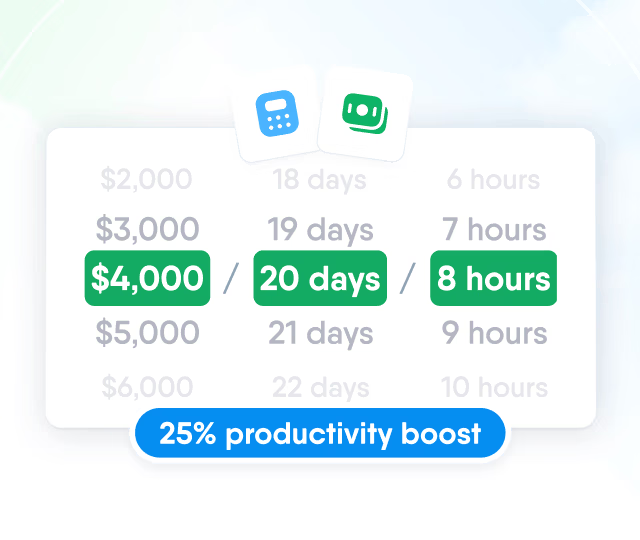
HR efficiency estimator
How does the HR efficiency estimator from PeopleForce work.
Calculate your impact



Employee empowerment
What is employee empowerment?
What is employee empowerment?
Employee empowerment means giving people the authority, information and resources to make decisions about their own work without asking permission for every step. It is not just delegating tasks: it is delegating decisions, within clear limits and with accountability for the results.
Empowerment is the opposite of micromanagement. Instead of controlling every detail, the leader sets the goal and the boundaries, and the team decides how to get there.
The four pillars of employee empowerment
Pillar | What it means | Example |
|---|---|---|
Authority | Freedom to decide within agreed limits | A sales rep approves discounts of up to 10% without escalating |
Information | Access to the data needed to decide well | The team sees department results and company goals |
Resources | Budget, tools and time to act | A project lead manages their own budget |
Accountability | Owning the outcome of decisions | Each person reviews their goals in 1:1s with their manager |
Benefits of employee empowerment
- Higher engagement: people who make decisions feel ownership of their work, which lifts employee engagement.
- Faster decisions: problems get solved where they appear, without waiting for several layers of approval.
- Better customer service: frontline staff can fix issues on the spot.
- Leadership development: making decisions is the best training for future managers.
- Lower turnover: autonomy is one of the strongest reasons people stay with an employer.
Examples of employee empowerment
- A support team can refund customers up to a set amount.
- Each team sets its own quarterly goals aligned with company objectives.
- Employees choose their working hours within an agreed window.
- A developer decides which tool to use to solve a technical problem.
How to empower employees
- Define the boundaries: which decisions each role can make and which it cannot.
- Share information: goals, metrics and business context.
- Train people for the decisions they will be making.
- Change the manager's role: from controlling to coaching, with more participative management styles.
- Accept mistakes as part of learning and review them without blame.
- Measure outcomes, not activity: judge what is achieved, not how many hours are worked.
Common mistakes
- Giving responsibility without authority: people are held accountable for results they cannot influence.
- Delegating without information: decisions are made blind.
- Taking autonomy away after the first mistake.
- Confusing empowerment with leaving the team alone, with no support or follow-up.
How PeopleForce helps
In Perform, each person sets goals aligned with team and company objectives and reviews them in 1:1 meetings with their manager. Pulse anonymous surveys show whether the team feels it has the autonomy to make decisions.
FAQ
What is employee empowerment?
It is giving employees the authority, information and resources to make decisions about their work, with accountability for the results.
What is the difference between empowerment and delegation?
Delegation hands over a task. Empowerment hands over the decision about how to do it and the freedom to solve problems without asking permission.
How do you measure employee empowerment?
Through engagement surveys that ask whether people feel able to make decisions about their work, and through indicators such as problem resolution time, engagement and turnover.


Let us show you what's possible
From Core HR to advanced workforce analytics — see the platform saving 80 hours a month for teams just like yours. Fully tailored to your workflow.