
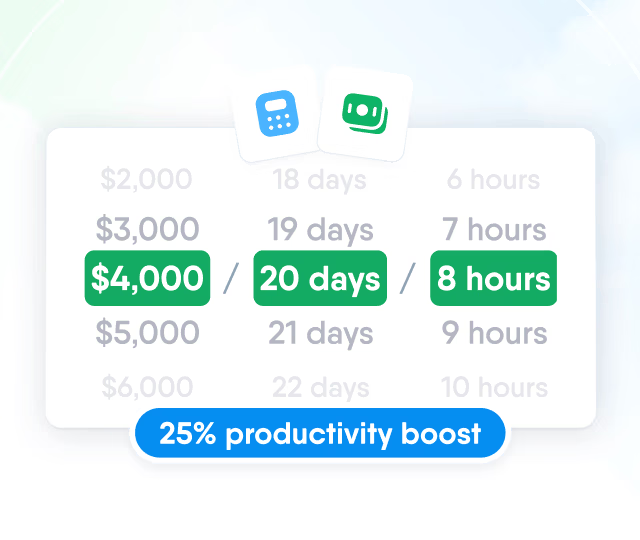
HR efficiency estimator
How does the HR efficiency estimator from PeopleForce work.
Calculate your impact



Professional development
What is professional development and why is it important?
Professional development is the personal improvement in his line of work, acquiring new skills, and work experience that can help achieve a career goal. It opens up broad horizons for executing the tasks set, realizing its potential, transforming life.
Professional development leads to increased demand for an employee, better and faster work performance, career advancement since professional development contributes to career growth.
Professional development consists of the following steps:
Step №1. Career guidance is a right choice of a sphere of activity and profession. It’s the first step that each of us takes at the start of a professional path.
Step №2. Professional education is a base of knowledge, hard and soft skills that serve as a starting point for professional development.
Step №3. Employment. It’s the most important step for professional development. Responsibilities and position affect how motivated you are to grow professionally.
Step №4. Competency development. Books, courses, master classes, internships, training, additional education are effective professional development and growth, which traditionally leads to career growth .
Why is professional development so important?
Professional development is important for several reasons:
- Exciting and varied work. By constantly developing, you can take on new, more complex, non-standard responsibilities. As a result, you will be attracted to various projects and new tasks. It helps to avoid routine and job dissatisfaction.
- Pay growth. Professionals with broad knowledge and qualifications who are regularly trained are more valuable talents. Monetary compensation for such employees is always higher.
- Career growth. Improving professionally, you can apply for a higher position and reach your professional Olympus faster over time.
What the difference between professional development and career growth
Career growth and professional development are interrelated concepts. That’s why they are often confused with each other. It is worth remembering that career growth is promoting an employee in a position based on his professional and personal skills.
Together, growth and development form the backbone of a successful career plan that brings satisfaction and good rewards.
Professional development methods
| Method | How it works | When it fits |
|---|---|---|
| Training and courses | Internal or external programmes, certifications | When specific knowledge is needed |
| Mentoring | A more experienced colleague shares know-how | When someone is settling into a new role |
| Coaching | A coach helps define goals and an action plan | For managers and career decisions |
| Job rotation | Temporary work in another team or role | To broaden business understanding |
| Upskilling and reskilling | Deepening current skills or retraining for a new role | When technology or processes change |
Development actions work best when they are gathered in an individual development plan with goals, deadlines and support from the company.
Professional development in the UK
In the UK, many professions require continuing professional development (CPD) to keep a professional registration, for example in accounting, law, engineering and healthcare. Separately, under the Employment Rights Act 1996, employees with at least 26 weeks' service in organisations with 250 or more employees have the statutory right to request time off for study or training, as the GOV.UK guidance on training rights explains. The employer must consider the request and can refuse it only for a valid business reason.
Professional development with PeopleForce
In the Perform module, development is tied to everyday work: performance reviews show which competencies to strengthen, goals turn development into measurable steps, and 1:1 meetings help managers review progress regularly.
FAQ
What is professional development in the workplace?
It is the set of actions a company uses to help employees gain new skills and experience: training, mentoring, coaching, stretch projects and career plans.
What is the difference between professional development and career growth?
Professional development is what a person learns and can do. Career growth is the move to a higher role, responsibility or salary that usually follows from it.


Let us show you what's possible
From Core HR to advanced workforce analytics — see the platform saving 80 hours a month for teams just like yours. Fully tailored to your workflow.