
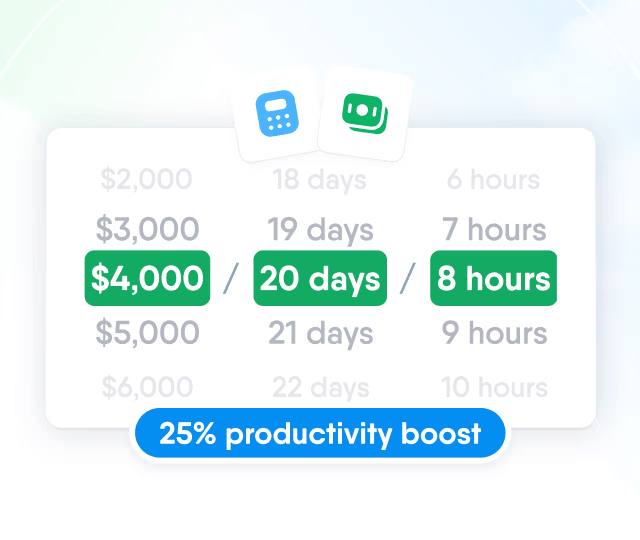
HR efficiency estimator
How does the HR efficiency estimator from PeopleForce work.
Calculate your impact



Job posting
A job posting is the public advertisement for an open role, written for candidates rather than for internal use, and increasingly governed by pay transparency rules.
A job posting is the public advertisement for an open role: the version of the job that candidates actually read, published on a career site, a job board or a professional network. It is not the same document as the job description, which is an internal artefact used for levelling, compensation and performance, and which almost always makes a poor advertisement when published unchanged.
That confusion is the root of most weak postings. A job description answers what the role is accountable for. A posting has to answer a different question: why would a specific person, who currently has a job, spend twenty minutes applying.
What belongs in one
- A title people search for. Internal titles like Growth Ninja or Specialist II get no traffic, because nobody types them into a search box.
- Pay. Increasingly a legal requirement rather than a choice, and covered below.
- Location and working model, stated precisely. Remote, hybrid with a number of office days, or on site. Hybrid without the number is the most common source of wasted interviews.
- What the person will actually do. Three to five concrete outcomes for the first year beat a list of twelve responsibilities copied from the job description.
- Requirements split into real and preferred. A long undifferentiated list filters out candidates who would have succeeded, and the effect is stronger among people who read requirements literally.
- The process. How many stages, what happens at each, roughly how long. This costs nothing and measurably increases completed applications.
What does not belong: the phrase fast-paced environment, a paragraph about the company's founding year before anything about the job, and a requirements list that describes the person who just left rather than the person you need next.
Pay transparency is now a legal question
The rules have moved quickly and they are no longer optional in much of Europe. The EU Pay Transparency Directive must be transposed by member states by 7 June 2026, and Poland went first: since 24 December 2025 employers there must tell a candidate the starting pay or the pay range for the role, either in the advertisement itself or before the interview, based on objective and gender-neutral criteria. The same amendment requires gender-neutral job titles and wording, and makes it unlawful to ask a candidate what they earned previously, though asking about their expectations is still allowed.
Two practical consequences follow. Job ad templates and recruiter scripts need reviewing wherever you hire, not just where your head office is, because the obligation follows the role. And publishing a range means your existing employees will read it, which is usually where the real work starts: a range you are not willing to show your own team is a pay structure problem rather than an advertising one. See salary benchmarking for the groundwork.
Getting it found
A posting nobody sees is a document, not an advertisement. The title carries most of the search weight, so it should match what candidates search rather than what the org chart says. Aggregators and Google for Jobs read structured data from the page, which means a posting published through a system that emits proper job markup gets indexed while a PDF or an image does not. Beyond that, distribution is the multiplier: the same text on your career site, on the boards that matter locally, and in the hands of employees who can share it.
The measurement that matters is not views. It is views to applications, and applications to candidates who pass screening. A posting with high traffic and no qualified applicants is usually a title or requirements problem; one with low traffic and a good pass rate is a distribution problem. Those are different fixes, and the numbers tell you which one you have.
Where postings quietly fail
Requirement inflation is the biggest one: ten years of experience for a mid-level role, or a degree requirement nobody would actually enforce. Gendered wording is the second, and it is usually unintentional, sitting in words like aggressive, dominant or rockstar. The third is a posting that never closes, so a role filled in March is still collecting applications in August and quietly damaging the employer brand of a company that never replies. And the fourth is the application form behind it: every additional field costs completions, and asking someone to retype a CV they already attached costs the most of all.
Job postings in PeopleForce
A vacancy in PeopleRecruit holds the posting content and its own application form: the fields shown to candidates on the career site are configured per vacancy, so a senior role can ask for a cover letter while a high-volume one asks for a name, an email and a CV. The career site can run on your own domain, and GDPR consent can be collected in the same form where that is switched on. Publication is deliberate rather than automatic, so a role can exist in the system without being visible anywhere.
Distribution runs through multiposting campaigns, where each board is a channel with its own settings and its own publication state, including the local boards that matter in these markets: Work.ua, Robota.ua, Djinni and HeadHunter, alongside the VONQ network. Each channel has a duration, thirty days by default, which is the mechanism that stops the never-closing posting above, and a failed or unauthorised posting is visible as such rather than silently absent. Applications from every channel land in the same pipeline with their source attached, so the view-to-application and application-to-screening numbers are available per posting without anyone assembling them by hand.


Let us show you what's possible
From Core HR to advanced workforce analytics — see the platform saving 80 hours a month for teams just like yours. Fully tailored to your workflow.