
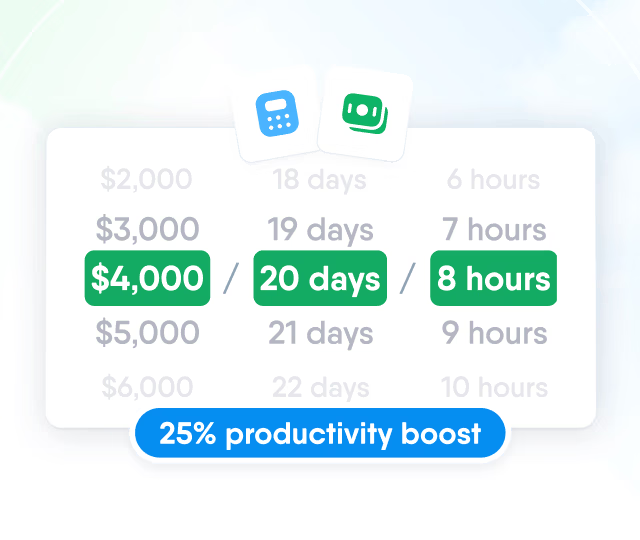
HR efficiency estimator
How does the HR efficiency estimator from PeopleForce work.
Calculate your impact



Blended learning
What blended learning is, which models companies use, what belongs online and what needs a live session, and how to design a programme
What is blended learning?
Blended learning is a way of training that combines online lessons people take at their own pace with live sessions led by a trainer and with practice on the job. Each part does what it is best at: the online part delivers knowledge, the live part gives discussion and feedback, and the practice turns both into a skill. The online part is e-learning, usually hosted in a learning management system.
Companies choose the blended format when a subject is too complex for a self-paced course alone and a classroom course alone would cost too much or take people away from work for too long. In learning and development it is the usual format for manager training, sales programmes and the onboarding process.
Blended learning models
| Model | How it works | Where it fits |
|---|---|---|
| Flipped classroom | Theory online before the session, the live time goes to cases and practice | Manager training, sales skills, product knowledge |
| Live-led with online support | Workshops are the core, online lessons prepare for them and reinforce them afterwards | Leadership programmes, soft skills |
| Online-led with live checkpoints | Most of the course is self-paced, with a few live sessions for questions and assessment | Technical and compliance subjects, distributed teams |
| Rotation | A group moves on a schedule between online modules, workshops and practice at the workplace | Onboarding, apprenticeships, production roles |
| Self-paced with a mentor | A person studies online and meets a mentor or a manager at agreed points | Individual development plans, new managers |
What goes online and what stays live
- Online: theory, terminology, rules and procedures, product knowledge, demonstrations on video, knowledge tests, and short refreshers in the form of microlearning.
- Live: role plays, difficult conversations, group work on real cases, questions to an expert, and assessment of a skill that has to be observed.
- On the job: a task applied to a real situation, with feedback from a manager through coaching or mentoring.
How to design a blended programme
- Start from the result: what people should do differently at work, based on a training needs analysis.
- Split the content: knowledge goes online, practice and discussion go to live sessions.
- Make the online part a condition of the live one. A session starts from the assumption that everyone has done the pre-work.
- Set a deadline for each stage and form cohorts, so that a group reaches the workshop at the same level.
- Give a practical task after every live session and agree who gives feedback on it.
- Track completion of the online part before the session, not after it.
- Measure the result: test scores, completed tasks and the change in work indicators.
Blended learning and working time in the UK
The online part of a blended programme is often done outside the usual schedule, and that has a legal side. Under the National Minimum Wage Regulations 2015, time a worker spends on training required by the employer counts as working time for minimum wage purposes, so modules assigned for an evening or a weekend are paid hours. Under the Working Time Regulations 1998, job-related training also counts towards the 48-hour weekly average. Planning online lessons inside working hours and recording the time spent removes both risks.
Blended learning in PeopleForce
PeopleForce Learn covers the online part of a blended programme, while live sessions take place in a classroom or on a video call. A course is built from text, video, audio, embedded pages, tests and SCORM packages, and an assignment lesson lets a learner send in a file or record video, audio or their screen as the practical task after a session. Training groups work as cohorts: people are added by department, position, location, manager or hire date, and the group gets either a fixed due date or a number of days to finish. Reminders go to those who have not completed a course, and completion is tracked for each person, so a trainer can see before the workshop who has done the pre-work.
Frequently asked questions
What is the difference between blended and hybrid learning?
In blended learning every participant goes through both parts: online lessons and live sessions. In hybrid learning one live session is attended at the same time by people in the room and by people who join remotely. A programme can be both blended and hybrid.
How much of a blended programme should be online?
There is no fixed ratio. The split follows the content: the more a programme is about knowledge and rules, the larger the online part, and the more it is about behaviour and skills, the more live time and practice it needs.


Let us show you what's possible
From Core HR to advanced workforce analytics — see the platform saving 80 hours a month for teams just like yours. Fully tailored to your workflow.