
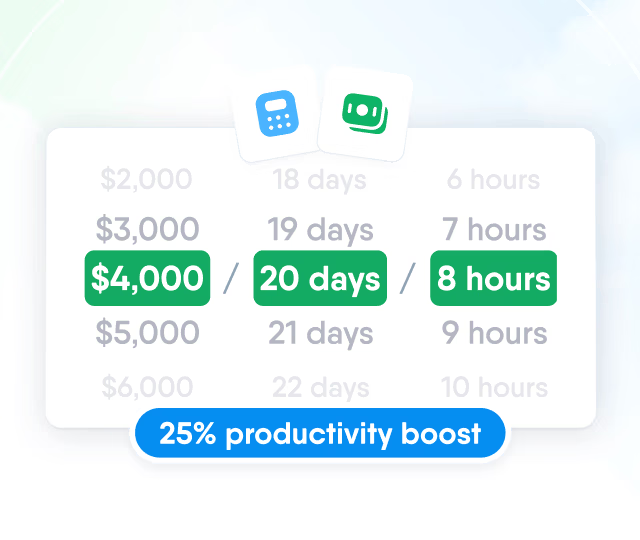
HR efficiency estimator
How does the HR efficiency estimator from PeopleForce work.
Calculate your impact



Hiring manager
The person a new hire will report to and who makes the final call. What the role covers, where it slows hiring down, and how to fix that.
A hiring manager is the person a new employee will report to, and the one who owns the decision about who gets hired. They are not the recruiter. The recruiter runs the process and protects the candidate experience; the hiring manager defines what the role needs to deliver and carries the consequences of getting it wrong for the next two years.
Hiring manager vs recruiter
The split matters because most slow or failed searches come from blurring it. The recruiter owns sourcing, scheduling, the pipeline and the candidate relationship. The hiring manager owns the job description, the definition of a strong hire, feedback within a working day, and the final yes or no. Where a company uses a HR business partner, that person advises on level, pay band and internal fairness, but the hiring decision still sits with the manager who will lead the person.
What the role actually involves
The visible part is interviewing. The part that determines the outcome happens before and after:
- Raising and justifying the vacancy: why this role, why now, what happens if it stays open.
- Writing the real requirements, separating what someone must arrive with from what they can learn in the first quarter.
- Agreeing the assessment approach with the recruiter, including who evaluates what, so the panel is not four people asking the same questions.
- Giving feedback fast enough that strong candidates are not lost to a competitor who moved in three days.
- Making the decision and owning the onboarding process afterwards, since a good hire badly onboarded still fails.
Why hiring managers become the bottleneck
In most companies the recruiting metric that moves least is the one the recruiter cannot control: manager response time. Interview feedback sitting for a week, scheduling that takes ten days, requirements that change after the first five candidates have been rejected. All of it lands in time to fill and gets read as a recruiting problem. The underlying cause is usually that hiring is nobody's actual job description: it is added on top of a full workload with no time allocated and no accountability attached.
The second recurring failure is unstructured interviewing. A manager who improvises questions is measuring rapport rather than capability, which is how unconscious bias enters the decision unnoticed. A structured interview with the same questions and a written rating scale is the single change with the largest effect on quality of hire.
How PeopleForce structures the manager's part
The mechanics of the role are handled across PeopleRecruit and Core HR. A hiring manager opens a role by submitting a vacancy request form, which routes through an approval chain before anything is published, so the justification exists in writing rather than in a corridor conversation. The request can be tied to a planned headcount position that already carries its department, location, manager, FTE and salary, with a status that moves from vacant to recruiting to filled. Vacancy fields can be configured so the hiring manager fills them in and the vacancy description is pre-populated from their answers instead of being rewritten by the recruiter.
For assessment, interview scorecards attach a fixed question set and rating scale to each interview, so every interviewer answers the same things and the comparison between candidates is real. Where agencies are involved, external recruiters get scoped permissions that limit them to their own candidates and can withhold salary and sensitive fields entirely.
How to make hiring managers better at it
Treat the capability as a skill to be built rather than assumed. Practically: train managers on structured interviewing before they sit on a panel, agree an explicit feedback deadline and measure against it the same way you measure the recruiter, and review outcomes at the six month mark by asking which hires are performing and which interview signals predicted that. Managers who see their own hiring outcomes get better at it quickly. Managers who never learn what happened to the people they rejected or chose do not.


Let us show you what's possible
From Core HR to advanced workforce analytics — see the platform saving 80 hours a month for teams just like yours. Fully tailored to your workflow.