
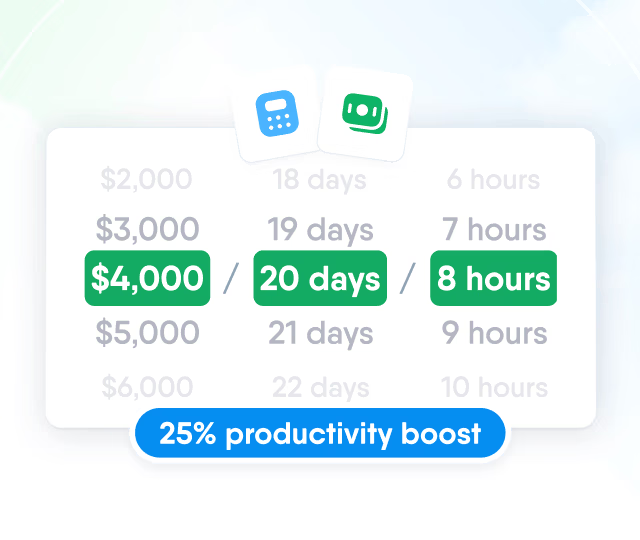
HR efficiency estimator
How does the HR efficiency estimator from PeopleForce work.
Calculate your impact



Interview scorecard
An interview scorecard is a structured form each interviewer completes after an interview, rating a candidate against criteria agreed before the process started.
An interview scorecard is a form each interviewer fills in after an interview, with criteria defined before the process started and a rating scale applied the same way to every candidate. It converts an interview from an impression into evidence that another person can read, disagree with and compare.
It is the operational half of the structured interview: the structure decides what gets asked, the scorecard decides what gets recorded. Without the second, the first decays back into a conversation within about three hires.
Why it changes the decision
Three mechanisms, all of them unglamorous. Memory fades and reshapes itself: by the debrief, an interviewer mostly remembers the beginning, the end and one vivid moment. Ratings written down before discussion resist the room: in an unrecorded debrief the most senior or most confident voice moves everyone else, and nobody notices it happening. And criteria fixed in advance are what stop the standard from moving candidate by candidate, which is where the halo effect and unconscious bias do most of their work.
There is a second-order benefit that matters more over time. Scorecards make the process auditable: you can look back at a year of hires and ask which criteria actually predicted who succeeded, which is impossible when the record is a set of thumbs up in a chat thread.
What goes on one
- Four to six criteria, no more. Taken from the role's actual requirements. Ten criteria produce ten fours.
- A rating scale with described levels. Not 1 to 5 in the abstract, but a written description of what a 3 looks like versus a 4, so two interviewers mean the same thing by the same number.
- An evidence field per criterion. What the candidate said or did that produced the rating. This is the single field that separates a scorecard from a survey.
- An overall recommendation. Hire or not, stated plainly, and separate from the individual ratings so a clear no on one critical criterion does not get averaged into a yes.
- Nothing called culture fit. Undefined, it becomes a socially acceptable place to record that someone felt unfamiliar. If the company means specific behaviours, name the behaviours and rate those.
How to run it
Split the criteria across the panel so each interviewer assesses two or three things deeply instead of everyone skimming everything. That also removes the repetition candidates hate, where four people ask the same question about the same project.
Submit before the debrief, not during it, and ideally within an hour of the interview. Then run the debrief from the divergences: two interviewers who rated the same criterion 2 and 5 have seen something the others did not, and that disagreement is the most useful twenty minutes in the whole process. The output is a decision plus a written reason, which is also what makes rejection feedback possible without inventing it afterwards.
Where scorecards fail
The most common is the ceremonial scorecard: filled in a week later from memory, to satisfy a process, with the rating chosen to match a decision already made. The second is inflation, where everyone scores 4 out of 5 because a 2 feels rude, and the scale stops carrying information. The third is treating the average as the decision, which lets strength in easy criteria cancel a fatal weakness in a critical one. And the fourth is a scorecard nobody ever looks at again, which removes the entire audit benefit and turns the exercise into paperwork that interviewers learn to resent.
Interview scorecards in PeopleForce
In PeopleRecruit a scorecard is a reusable template of questions attached to interviews, and each interviewer gets their own instance for a given candidate rather than a shared document. Question types cover rating, select, multi-select, checkbox and free text, and any of them can be marked required, so a scorecard with an empty critical criterion cannot be submitted at all.
The submit step is the one that carries the design above. A scorecard saves as a draft while the interviewer works on it and becomes submitted with a timestamp when they finish, which is what makes the fill-in-before-the-debrief rule enforceable rather than aspirational. Submission requires an overall rating from 1 to 5, notifies the recruiter and the hiring leads of the relevant vacancies, and writes an event onto the candidate's recruitment timeline. Submitted ratings roll up automatically into a candidate evaluation score on a 0 to 100 scale, recalculated as each new scorecard lands, and the whole set exports to CSV with one column per question, which is where the inflation problem above becomes visible: one interviewer whose ratings never leave the middle shows up immediately.


Let us show you what's possible
From Core HR to advanced workforce analytics — see the platform saving 80 hours a month for teams just like yours. Fully tailored to your workflow.