
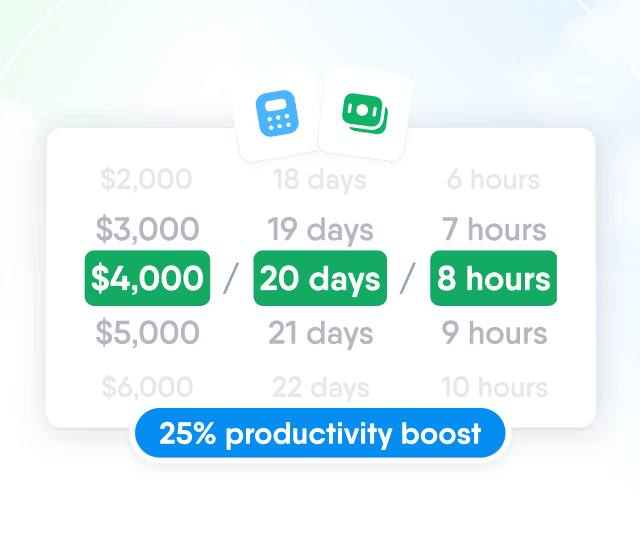
HR efficiency estimator
How does the HR efficiency estimator from PeopleForce work.
Calculate your impact



Talent pool
A talent pool is a maintained group of candidates a company could hire in the future, built from past applicants, sourced professionals, referrals and former employees.
A talent pool is a maintained group of people a company could hire later but is not hiring right now. It usually holds strong candidates who lost out on an earlier role, passive professionals found through sourcing, referrals, contacts from events, former employees and interns. The word also gets used for internal pools, meaning current employees identified as ready for a different or bigger role.
The promise is straightforward: when a role opens, you start with a shortlist instead of an empty pipeline. The reality is that most talent pools are a database of people who were contacted once and never again, which is worse than nothing, because it gives a false sense of coverage while quietly ageing.
Where the people in it actually come from
- Silver medalists. The most valuable group by a distance. They completed your process, cleared your bar and were beaten by one person. They already know the company and have a reason to answer.
- Past applicants who were early rather than wrong. A candidate rejected for lacking two years of experience becomes a fit in two years.
- Sourced passive candidates. People who were not looking when you found them. Their availability changes on a schedule you cannot see, which is exactly why the pool needs periodic contact.
- Referrals with no open role. An employee referral program produces good people at the wrong moment constantly, and most companies discard them.
- Former employees. A boomerang employee needs no onboarding on how the company works, and exit records tell you who left on good terms.
- Interns and alumni of your own programs. An internship is a long assessment that most companies fail to convert.
A pool that is not maintained is a list
Candidate data decays fast. People change jobs, get promoted, move city, change what they want. A contact record eighteen months old is a guess about a person who no longer exists in that form, and the only fix is contact that the recipient does not experience as spam.
What works is narrow and honest: a short note when something genuinely relevant happens, addressed to a specific group rather than to everyone in the database. A new team opening in their specialism. A product launch they would find interesting. A direct question about whether their situation has changed, sent by the recruiter they actually spoke to rather than from a no-reply address. Segmentation is what makes this possible, so a pool needs structure from the start: by role family, by seniority, by location and by how warm the relationship is.
Two metrics tell you whether the pool is real. What share of hires came from it, and what the response rate is when you contact it. A pool of four thousand records with a three percent response rate is smaller in practice than a curated list of eighty people who reply.
Consent and retention are not a footnote
Keeping candidate data after a recruitment process ends requires a legal basis, and in the EU that normally means explicit, informed consent to be kept for future opportunities, obtained separately from the application itself. Consent is time-limited, the candidate can withdraw it at any moment, and they can ask what you hold and ask for it to be deleted. Ukraine, Poland and most of Latin America have converged on similar rules; the specifics differ, the obligation does not.
Practically this means three things: ask at the point of application, record when consent was given and when it expires, and delete rather than archive when it lapses. A pool built on data kept without consent is a liability disguised as an asset, and it usually surfaces at the worst moment. See also GDPR and data protection.
Internal pools are a different instrument
An internal talent pool lists current employees ready for a bigger or different role, and it feeds internal recruitment and succession decisions rather than hiring campaigns. The failure mode here is specific and worth naming: a list of high potentials that is secret from the people on it, and from the people not on it, produces neither development nor retention. If being in the pool has no visible consequence, it is a spreadsheet that quietly demotivates everyone who finds out about it.
Talent pools in PeopleForce
In PeopleRecruit a talent pool is a named object rather than a tag convention, and a candidate can sit in several pools at once, so the same person can be in backend engineers, Warsaw and silver medalists without duplicate records. Pools can be archived when a hiring programme ends instead of being deleted, which keeps the history without cluttering the list recruiters work from. Tags, sources and structured candidate fields give you the segmentation the outreach above depends on, and the candidate profile keeps past applications, interview notes and scorecards attached, so whoever picks the conversation up in a year is not starting cold.
The consent side is handled as data rather than as a policy document. Each candidate carries a GDPR consent record with its own status, which is not simply yes or no: it is none, accepted, rejected or expired, with the dates of consent, rejection and expiry stored alongside. Consent can be collected on the career site application form when that is switched on, and the status is filterable, so the question of who you may legally contact has an answer you can query rather than an answer you have to reconstruct.


Let us show you what's possible
From Core HR to advanced workforce analytics — see the platform saving 80 hours a month for teams just like yours. Fully tailored to your workflow.