
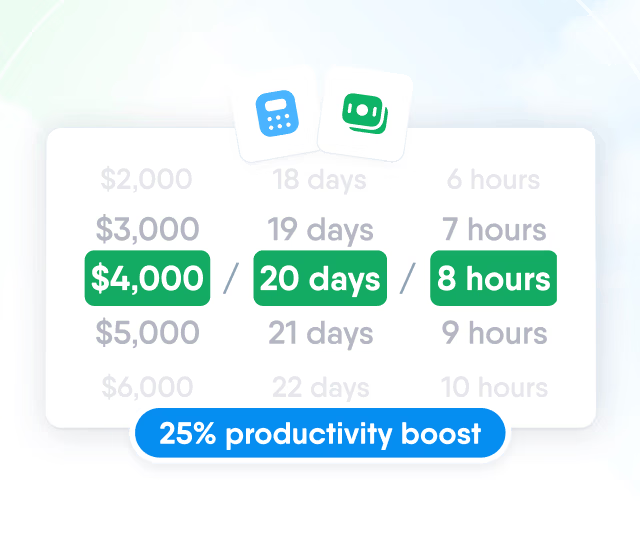
HR efficiency estimator
How does the HR efficiency estimator from PeopleForce work.
Calculate your impact



Job offer: what to include, template and examples for Ukraine and the UK

A job offer is the written proposal an employer sends a candidate after successful interviews. It sets out the role, start date, pay and other terms of the future employment. Its legal weight depends on the country: in Ukraine an offer does not create an employment relationship, while in the UK an accepted unconditional offer already forms a contract.
This guide covers what to include, a template you can copy, examples for different roles, how to handle negotiation and the mistakes that cost companies candidates.
Key facts
Ukraine: an offer is not an employment contract. Employment starts with a contract and a hiring order.
UK: once a candidate accepts an unconditional offer, a contract exists. Withdrawing it can mean paying damages, usually notice pay.
Conditional offers in the UK typically depend on right to work checks, references and sometimes DBS checks.
Always state gross or net and the pay period: monthly in Ukraine, usually annual in the UK.
Is a job offer legally binding?
Ukraine
In Ukraine, employment begins when the employment contract is signed and the hiring order is issued, and the employer notifies the tax authority before work starts. The offer plays no part in this chain. The candidate can turn down an accepted offer without legal consequences, and the employer can formally withdraw it, although the reputational cost is far higher than the legal one. If the offer and the order differ, the order and contract prevail.
United Kingdom
In the UK, an offer and acceptance form a contract. If the offer was unconditional, or all its conditions have been met, withdrawing it is a breach of contract. Damages are usually limited to what the candidate would have earned during the contractual notice period, which is why many offers include a short notice period during probation.
Most UK offers are conditional: subject to right to work checks, satisfactory references, proof of qualifications and, for some roles, a DBS check. If a condition is not met, the employer can withdraw the offer, provided the reason is genuine and not discriminatory. Employers must also give a written statement of employment particulars on or before day one.
Question | Ukraine | United Kingdom |
|---|---|---|
Does an accepted offer create a contract? | No, a contract and hiring order are needed | Yes, if unconditional or conditions are met |
Can the employer withdraw it? | Formally yes, at a reputational cost | Only if a condition fails; otherwise breach of contract |
Typical conditions | Not common | Right to work, references, qualifications, DBS |
How pay is stated | Monthly, gross or net stated | Annual gross salary |
What to include in a job offer
Job title: the exact title that will appear in the contract.
Reporting line: manager's name and title, team.
Start date: a specific day, allowing for the candidate's notice period.
Working pattern: office, hybrid or remote, hours, time zone.
Pay: amount, gross or net, currency, pay dates.
Bonus: what it is for, how it is calculated, when it is paid.
Benefits: holiday, sick pay, pension, health insurance, learning budget, equipment.
Probation: length and how it is assessed.
Conditions (UK): checks the offer depends on.
Deadline: the date you expect a reply by.
Job offer template
Subject: Job offer: [job title] at [company]
Dear [name],
Thank you for the time you spent with us during the interviews. We are delighted to offer you the role of [job title] in the [team] team.
Terms
Job title: [title]
Reports to: [name, title]
Start date: [date]
Working pattern: [office / hybrid / remote], [hours]
Salary: [amount] [gross / net] per [month / year], paid on [date]
Bonus: [description or “not applicable”]
Probation: [length]
Benefits: [list]
Conditions
This offer is subject to [right to work check, satisfactory references, other].
Next steps
Please let us know your decision by [date]. Once you accept, we will send the documents needed to complete your hiring and a plan for your first week.
If you have any questions, please contact me directly.
[name], [title], [contact details]
Examples by role type
Office-based role
Focus on day-to-day details that affect the decision: office address, hours, commute, parking, meals and how many office days a hybrid pattern involves. For Ukrainian offices, add how the team works during air raid alerts and power outages: candidates almost always ask, and it is better to answer up front.
Remote role
Add three points an office offer does not need: overlapping hours with the team, who provides equipment, and how documents are signed remotely, for example with an electronic signature.
Senior leadership role
The offer is longer and almost always precedes a separate service agreement. Add the scope of authority, long-term incentives, confidentiality and restrictive covenants, and termination terms on both sides.
How to present an offer so it gets accepted
- Call first, then email. The candidate should hear the offer and be able to ask questions straight away.
- Explain the number. Not just the figure but the logic: level, team band, next review.
- Give a realistic deadline. Two or three working days is normal. “We need an answer today” reads as pressure.
- Send it in writing the same day. Verbal agreements without an email are the most common source of misunderstanding.
- Stay in touch until day one. The time between acceptance and start is when candidates most often receive counter-offers.
When the candidate negotiates
Negotiation is a normal part of the process. Agree the band for the role and the maximum you can go to before the offer goes out.
- If the request is within the band, agree and send an updated written offer straight away.
- If it is above the band, look for non-salary levers: a review after six months, extra holiday, a learning budget, flexible hours.
- If the gap is large, say honestly that it is outside the band. An inflated offer breaks the pay structure and comes back as a problem inside the team.
Common mistakes
No gross or net. The most common conflict with the first payslip.
Vague bonus. “Up to 30% based on performance” without criteria reads as a promise.
No deadline. The offer stays open for weeks while the role sits empty.
Withdrawing an unconditional offer in the UK. It is a breach of contract, not just bad practice.
Silence after acceptance. The candidate is left alone with the decision and open to counter-offers.
How to keep offers under control
With a few offers a month, email works. With dozens, wording drifts and replies get lost. In the Recruit module, an offer is built from a template that fills in the candidate, vacancy, hiring manager and sender details automatically, so no required point is missed.
Each offer has its own status: draft, sent, viewed by the candidate, accepted, declined or cancelled. That answers the most frustrating question in recruiting, “did they even open it?”, and gives real offer acceptance rates by team and vacancy. More on the concept in our glossary entry on the offer letter.
Frequently asked questions
What is a job offer?
A written proposal of employment with specific terms: role, start date, pay, working pattern and benefits. It is sent after interviews and before hiring paperwork.
Can an employer withdraw a job offer?
In Ukraine, formally yes, because there is no employment relationship yet. In the UK, only if a condition is not met; withdrawing an accepted unconditional offer is a breach of contract.
What is a conditional job offer?
An offer that depends on checks such as right to work, references, qualifications or a DBS check. It becomes unconditional once those checks are complete.
Should the offer state salary as gross or net?
It should always say which. In the UK, salary is usually stated as a gross annual figure. In Ukraine, a monthly figure is common, and gross or net must be stated explicitly.
How long should a job offer stay open?
As long as it says. Two or three working days is typical for individual contributor roles and up to a week for leadership roles.
The PeopleForce editorial team creates and refines content on people management, recruiting, team development and HR technology. Every article goes through an editorial review for accuracy, relevance and clarity. We rely on verified sources, industry research, hands-on experience and PeopleForce’s own analytics, including anonymized data, to give HR professionals, managers and business owners useful, reliable information.


One login. Every HR tool you'll need.
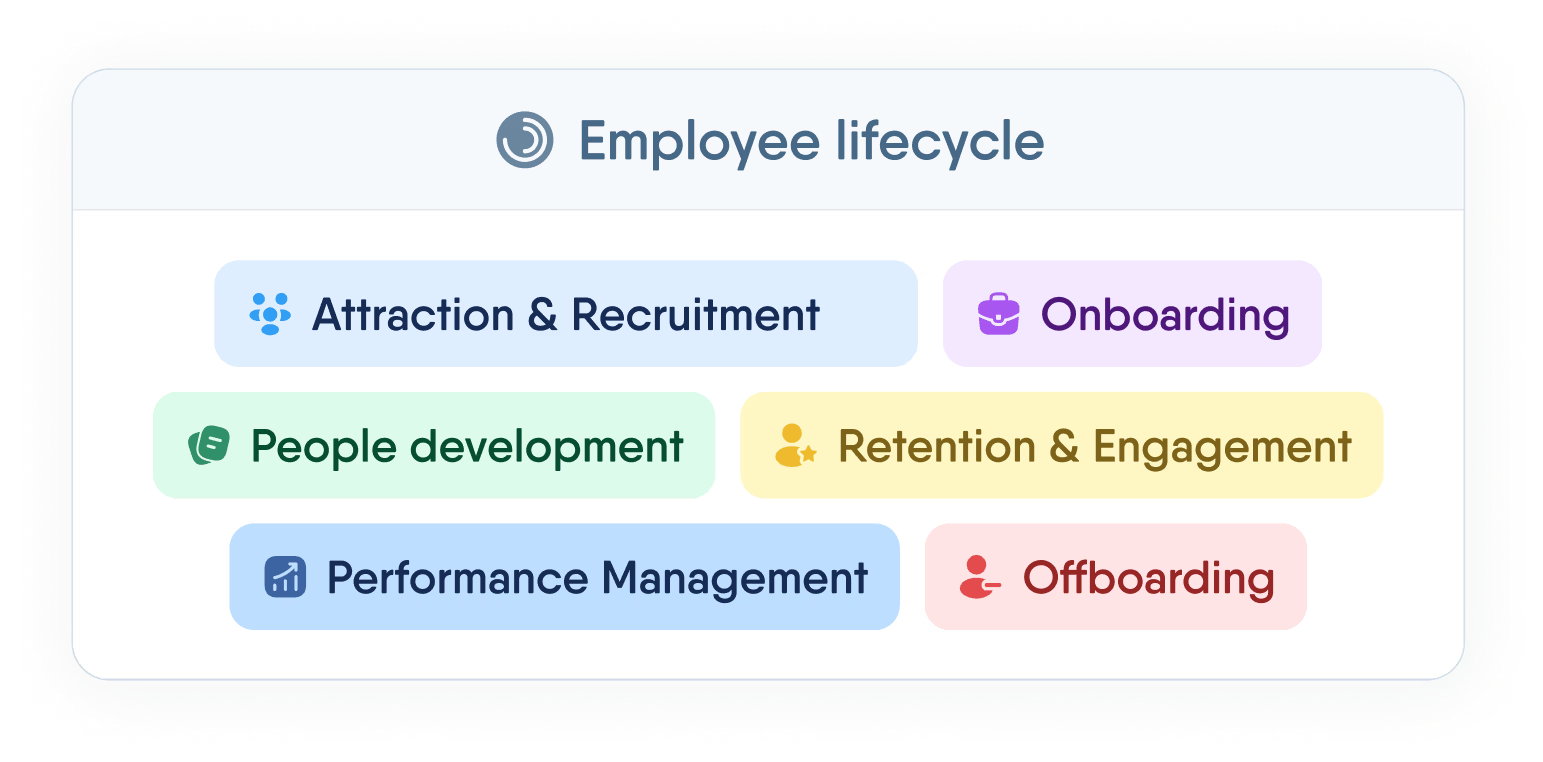
Manage the full employee lifecycle — from first interview to final offboarding — without switching tabs or losing data.
Recent articles
Employee KPIs: how to set them, measure them and keep motivation intact
What a KPI is, how to set KPIs in five steps, 30 examples by department, weighted achievement calculation and how to link KPIs to bonuses.
Soft skills vs hard skills: the difference and how to assess them
The difference between soft and hard skills, 30 soft skills explained, hard skills by profession and 18 behavioural interview questions.
Job description: templates and example duties for Ukraine and the UK
Structure of a job description in Ukraine and the UK, two templates, rules for wording duties and example duties by role.