
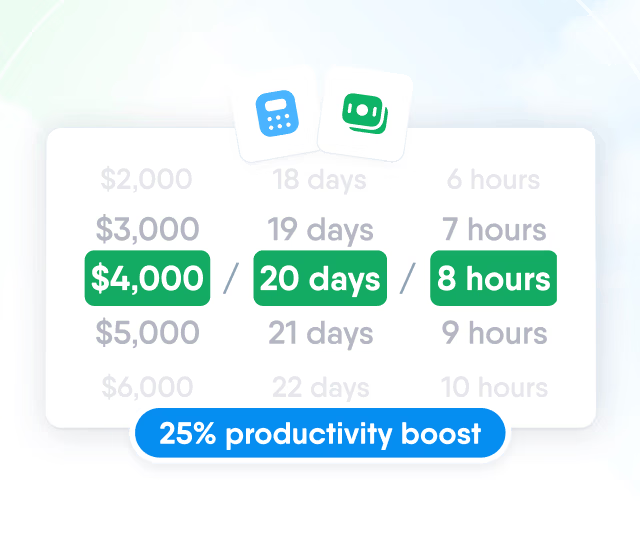
HR efficiency estimator
How does the HR efficiency estimator from PeopleForce work.
Calculate your impact



Soft skills vs hard skills: the difference and how to assess them

Hard skills are measurable professional abilities that are taught and proven by results: programming in Python, bookkeeping, working in Figma. Soft skills are behavioural abilities that show up in how someone works with people and tasks: communication, teamwork, managing their own time.
The practical difference is not which matters more but how you assess them. Hard skills show up in a one-hour test task. Soft skills never show up if you ask about them directly: they only appear when someone describes specific situations from their past experience.
Key points
Hard skills are gained through training; soft skills through the practice of working with others.
Hard skills are tested with a task; soft skills with behavioural questions using the STAR method.
Hard skills go out of date quickly; soft skills transfer between careers and last for decades.
Hire for both, but people are more often let go because of soft skills.
What are hard skills
Hard skills (also called technical or job-specific skills) are concrete abilities needed to do the work. They are tied to a profession, a tool or a methodology and can be described precisely: “writes SQL queries with window functions”, “manages the ledger in Xero”, “sets up Google Ads campaigns”.
Features of hard skills:
- they are gained through formal education, courses or on-the-job practice;
- they are proven by a degree, certificate or portfolio;
- they can be tested in a single session: a test task, case study or technical interview;
- they have a clear level that can be described on a scale;
- they age along with the tool or market requirements.
Hard skills are what usually appear in a job advert and decide whether someone can do the job at all. They are also the least stable part of a profile: the tool changes and the skill needs updating.
What are soft skills
Soft skills (also called interpersonal or people skills) are stable ways of acting in relationships with others and under uncertainty. They are not tied to a profession: being able to put an idea clearly is just as useful to a developer, an accountant or a sales manager.
Features of soft skills:
- they develop over years of experience, not on a single course;
- no document proves them, only behaviour in real situations;
- they transfer between roles, companies and industries;
- they are assessed indirectly: behavioural questions, feedback from colleagues, observation at work;
- they hardly ever go out of date.
The paradox of hiring is that people are mostly hired for their hard skills and mostly let go because of their soft skills: they did not fit into the team, could not carry the responsibility or did not hear the feedback.
Soft skills vs hard skills: the key differences
Criterion | Hard skills | Soft skills |
|---|---|---|
How they are gained | Training, courses, certification, practice with the tool | Working with others, feedback, mentoring, reflection |
How they are measured | Test, case study, technical interview, portfolio | Behavioural questions, 360-degree feedback, observation at work |
Objectivity of assessment | High: the result is either there or not | Medium: several sources are needed |
Transferability | Low: tied to the tool and industry | High: useful in any role |
How fast they age | 2 to 5 years, less for IT tools | Hardly at all |
How fast they develop | Weeks or months | Months or years |
Where they are recorded | Job advert requirements, competency matrix | Company values, role profile, performance review |
A third category is often confused with soft skills: meta skills, or the ability to learn. That means picking up new things quickly, learning from mistakes and carrying an approach from one task to another. Formally they are soft skills, but in practice they decide how fast someone closes a gap in their hard skills.
List of soft skills with examples
A list without explanation is useless: “good communicator” on a CV says nothing. Below are 30 soft skills in five groups, with what each one looks like at work. That is what you are looking for in an interview.
Communication
Skill | What it looks like at work |
|---|---|
Active listening | Asks questions and restates the task before starting on it |
Written communication | Writes emails and tickets that need no follow-up call |
Public speaking | Runs a product demo or a talk for 30 people without losing the thread |
Giving feedback | Raises a problem directly, about the action rather than the person |
Receiving feedback | Does not get defensive, asks clarifying questions, changes behaviour |
Negotiation | Agrees deadlines and scope without escalating to senior management |
Thinking
Skill | What it looks like at work |
|---|---|
Critical thinking | Checks the numbers in someone else's report before basing a decision on them |
Analytical thinking | Breaks a vague customer complaint down into testable hypotheses |
Problem solving | Comes to their manager with the problem and two possible solutions |
Systems thinking | Sees how a change in one process will affect the neighbouring team |
Creativity | Suggests a workaround when the budget blocks the usual route |
Attention to detail | Spots an inconsistency in a contract before it is signed |
Self-management
Skill | What it looks like at work |
|---|---|
Time management | Delivers on time without reminders or last-minute rushes |
Prioritisation | Decides what to park when three urgent tasks land at once |
Independence | Keeps work moving while their manager is on holiday |
Accountability | Flags a missed deadline in advance, not after the fact |
Resilience under pressure | Keeps decision quality high during peak periods and incidents |
Self-directed learning | Closes a skills gap without waiting for a company-paid course |
Leadership
Skill | What it looks like at work |
|---|---|
Delegation | Hands over a task with context and the authority to decide |
Mentoring | Gets a new starter working independently within a month instead of doing the work for them |
Decision making | Chooses an option with incomplete data and notes what would make them revisit it |
Conflict management | Brings both sides back to the facts rather than letting silence bury the tension |
Motivating the team | Explains the purpose of a task so everyone understands why it matters |
Influence without authority | Drives a change through a team they do not manage |
Adaptability
Skill | What it looks like at work |
|---|---|
Flexibility | Rebuilds the plan after priorities change without a week of resistance |
Working with ambiguity | Starts moving before requirements are final and refines them along the way |
Emotional intelligence | Notices a colleague is overloaded before they miss a deadline |
Teamwork | Puts the team's result ahead of their own area |
Cross-cultural communication | Works smoothly with a distributed team across time zones |
Customer focus | Asks what problem the customer is solving, not just what they are asking for |
Hard skills by profession
Hard skills are always tied to the role. Here is a core set for six common professions and how to test each one during hiring.
Profession | Key hard skills | How to test |
|---|---|---|
Developer | Programming language, databases, Git, testing, CI/CD, reading other people's code | Test task, live coding, walkthrough of a personal project |
Marketer | Analytics (GA4), paid campaigns, SEO, CRM, campaign unit economics | Case with real numbers, review of a past campaign, landing page audit |
Accountant | Bookkeeping and tax, source documents, payroll, accounting software such as Xero or Sage, reporting | Practical calculation, questions on recent rule changes |
Sales manager | Pipeline management, lead qualification, proposals, CRM, forecasting | Role-played customer call, review of their own numbers for the last quarter |
HR manager | Employment law, right-to-work checks, recruitment and assessment, HR analytics, HR systems | Case on handling an HR process, turnover calculation, job advert review |
Designer | Figma, typography, design systems, prototyping, responsive layouts | Portfolio with design rationale, test mock-up, critique of an existing interface |
How to assess soft skills in an interview
Asking “are you good under pressure?” tells you nothing: everyone says yes. What works is asking for a specific situation from the past and unpacking it with the STAR method.
Step | What you find out | Red flag |
|---|---|---|
S: Situation | The context, when it happened, who was involved | Answers in general terms: “usually in situations like that…” |
T: Task | What the candidate personally had to do | Cannot separate their role from the team's |
A: Action | What exactly they did and which options they considered | Says “we” and names no action of their own |
R: Result | How it ended and what they would do differently now | Does not know the outcome, or every story ends in success |
One rule: for each skill in the role profile, one question about past experience and at least two follow-ups on the Action step. It is the follow-ups, not the question, that show whether the story is real.
Communication and feedback
- Tell me about a time you had to explain something complex to someone without a technical background. How did you know they understood?
- Think of feedback you disagreed with. What did you do next?
- Describe a time you had to tell a colleague or manager something uncomfortable. How did you phrase it?
Teamwork and conflict
- Tell me about a conflict in a team you were part of. What was the other side's position?
- Has a colleague ever not done their part and blocked your work? What did you do?
- Give an example of changing your mind because of the team's arguments. What convinced you?
Accountability and independence
- Tell me about a mistake that cost the company money or time. How did you report it?
- Describe a decision you made without checking with your manager. Why did you do it that way?
- Was there a project you finished even though no one was pushing it? What did you do when attention faded?
Adaptability and ambiguity
- Think of a time priorities changed mid-way through your work. What happened to what you had already done?
- Tell me about a task you did not have the knowledge for at the start. How did you close the gap?
- Describe a situation with incomplete requirements where you still had to start. Where did you begin?
Prioritisation and working under pressure
- Tell me about a day when three tasks were urgent at the same time. How did you choose?
- Have you ever deliberately left part of the work undone? How did you agree that?
- Describe the most intense period in the last year. How did you know you were overloaded?
Leadership and influence
- Tell me how you got a new team member working independently. How long did it take?
- Have you had to push a change through a team you did not manage? How did you do it?
- Describe a decision you made with incomplete data. What would make you revisit it?
How to assess hard skills
Hard skills are more straightforward, but there is still a common trap: testing what is easy to test instead of what the job actually needs.
Method | What it shows | When it fits |
|---|---|---|
Test task | Real performance on a typical task | When the work has a measurable output; no more than 3 hours |
Portfolio or past case review | The logic behind decisions, not just the result | Design, marketing, analytics, management |
Practical task in the interview | Thinking in real time | Engineering, finance, customer support |
Interview with a subject expert | Depth, not vocabulary | Any role where mistakes are costly |
Knowledge test | Formal awareness of the topic | Only as a filter for high-volume hiring |
A certificate proves that someone completed training, not that they can do the work. It is a useful signal in regulated fields (accounting, health and safety, healthcare) and adds little where there is a portfolio.
How to develop skills in your team
Skills development works when it is tied to day-to-day work rather than an abstract annual plan. The sequence is:
Step | What to do |
|---|---|
1. Describe the role profile | List hard and soft skills with levels for each role. That is your competency matrix |
2. Measure the current level | Self-assessment plus manager assessment; for key roles, add peers and direct reports |
3. Find the gaps | Compare the required and actual levels and pick 2 or 3 skills, not ten |
4. Build a plan | 70% on-the-job tasks, 20% learning from others, 10% courses and reading |
5. Check in cycles | Reassess after 6 months on the same scale |
For soft skills, regular one-to-ones with specific feedback on behaviour work far better than a quarterly review. How to put such a plan together is covered in our entry on the individual development plan, and how to check soft skills from the hiring stage in soft skills in hiring.
How to keep your competency matrix up to date
A competency matrix in a spreadsheet lasts until the first reorganisation: levels go stale, review history gets lost and comparing someone with themselves a year ago becomes impossible. In the Perform module, competencies are defined once per role and assessments are collected in cycles: self-assessment, manager, peers, direct reports and external participants, which is full 360-degree feedback.
The results come together in two views: a team competency matrix showing shared weak spots and individual strengths, and a radar chart for each person, with their self-assessment next to how others see them. The gap between the two is usually the most useful topic for the next one-to-one, and what comes out of it becomes the goals for the next cycle.
Which skills to put on your CV
If you are job hunting, the rule is simple: list hard skills, and show soft skills through examples in your experience section.
Weak | Strong |
|---|---|
Good communicator, works well under pressure, team player | Ran weekly demos for 4 departments; delivered 30% above target in peak months without missed deadlines |
Responsible, natural leader | Brought two new starters to independent work within 6 weeks |
Excel, English | Excel: pivot tables, Power Query. Spanish: B2, business correspondence and calls |
Nobody reads or checks a separate list of soft skills. Recruiters read the verbs in your experience section, and those verbs are what prove your soft skills.
Common mistakes
Asking about soft skills directly. “Are you a team player?” gives you nothing; you need a real story.
Assessing from one source. One manager's view is an opinion, not an assessment of the skill.
Confusing personality traits with skills. Being an introvert does not stop someone communicating well; they are different things.
Chasing the perfect profile. A list of 15 must-have skills means the role has been imagined, not defined.
Requiring skills the company does not use. If managers never give feedback, the ability to take it will not be needed.
Assessing once a year. After 12 months the context is gone and the review reflects only the last month.
Frequently asked questions
What are soft skills in simple terms?
They are behavioural and interpersonal skills: how someone communicates, makes decisions, works in a team and reacts to change and pressure. They are not tied to a specific profession.
Which are more important, hard or soft skills?
Hard skills decide whether someone can do the job; soft skills decide whether they can do it with others and keep it up over time. Early in a career hard skills weigh more; in leadership roles it is the other way round.
Can soft skills be developed?
Yes, but not in a week. What works is specific feedback on behaviour, practice on real tasks and a fresh assessment a few months later.
How can I check soft skills in a single interview?
Pick the 3 or 4 skills that matter most for the role and, for each, ask about a specific past situation and unpack it with STAR. Testing ten skills in an hour is impossible.
How do soft skills differ from competencies?
A competency is a broader concept: the combination of knowledge, skills and behaviour needed to deliver results in a role. Soft skills are part of it, and a competency is always described through observable behaviour at a given level.
Do technical specialists need soft skills?
Yes, and they are what most often decides the step from mid-level to senior: explaining a decision, agreeing the scope of a task, giving feedback on a colleague's code.
The PeopleForce editorial team creates and refines content on people management, recruiting, team development and HR technology. Every article goes through an editorial review for accuracy, relevance and clarity. We rely on verified sources, industry research, hands-on experience and PeopleForce’s own analytics, including anonymized data, to give HR professionals, managers and business owners useful, reliable information.


One login. Every HR tool you'll need.
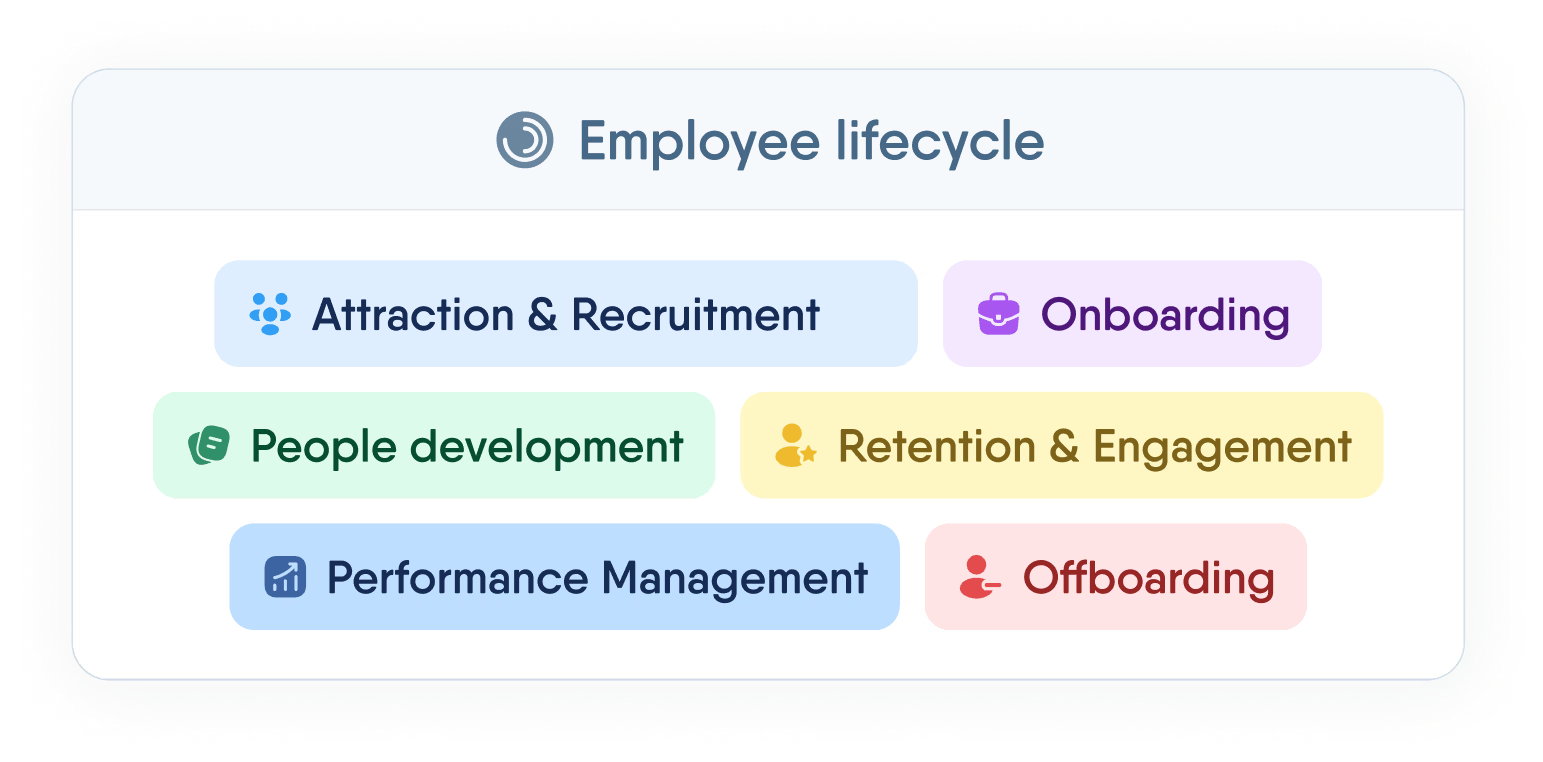
Manage the full employee lifecycle — from first interview to final offboarding — without switching tabs or losing data.
Recent articles
Employee KPIs: how to set them, measure them and keep motivation intact
What a KPI is, how to set KPIs in five steps, 30 examples by department, weighted achievement calculation and how to link KPIs to bonuses.
Job offer: what to include, template and examples for Ukraine and the UK
Legal status of a job offer in Ukraine and the UK, what to include, a template, examples by role type and negotiation tips.
Job description: templates and example duties for Ukraine and the UK
Structure of a job description in Ukraine and the UK, two templates, rules for wording duties and example duties by role.