
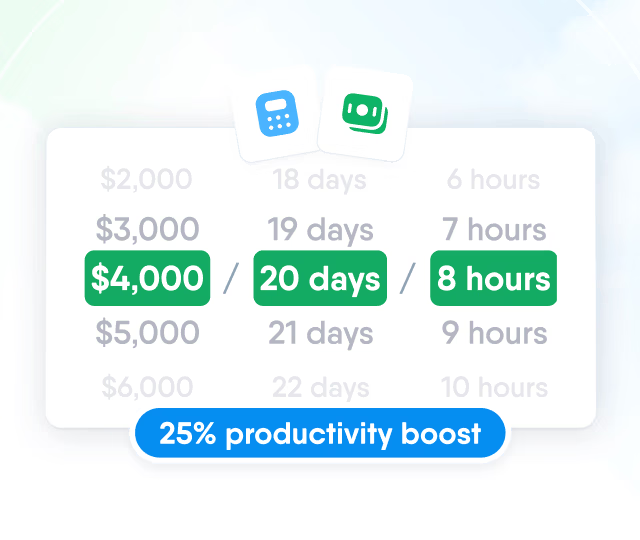
HR efficiency estimator
How does the HR efficiency estimator from PeopleForce work.
Calculate your impact



Employee bonus
What an employee bonus is, which types companies use, how to build a bonus scheme and what the law says about contractual and discretionary bonuses
What is an employee bonus?
An employee bonus is a payment made on top of base salary, usually for results, a specific achievement or staying with the company. Unlike salary, it is not guaranteed every pay period: it depends on conditions the employer sets or on the employer's decision.
Bonuses are the most common form of variable pay and a visible part of total compensation. For the business they tie pay costs to results. For employees they show what the company values, which is why unclear bonus rules undo most of that effect.
Types of bonuses
| Type | What it rewards | When it is paid |
|---|---|---|
| Performance bonus | Individual results against agreed goals or KPIs | Monthly, quarterly or yearly |
| Team or company bonus | Shared results: a project, revenue, profit | Quarterly or yearly |
| Spot bonus | A one-off contribution beyond the role | Right after the event |
| Signing bonus | Accepting a job offer | On joining or after probation |
| Retention bonus | Staying through a critical period | At the end of the agreed period |
| Referral bonus | Recommending a candidate who gets hired through an employee referral programme | After the new hire passes probation |
A bonus rewards what has already happened. Incentive pay works the other way round: the formula is announced in advance to steer behaviour, as with sales commission. Many schemes mix both.
How to set up a bonus scheme
- Decide what the bonus is for and how much the company can spend on it in a good year and in a bad one.
- Choose measurable criteria: a key performance indicator, progress on OKRs or a performance review rating.
- Fix the formula: a target amount or a percentage of salary, thresholds and a cap.
- Write the eligibility rules: who takes part, what happens to joiners, leavers and people on long leave, and how part-time work is counted.
- Put the scheme in a written policy and explain it to managers and employees before the period starts.
- Review after each cycle: who received what, and whether the bonus moved the result it was meant to move.
Bonuses and UK law
In the UK the key question is whether a bonus is contractual or discretionary. According to Acas guidance on bonuses, an employer must pay a contractual bonus once the agreed criteria are met, and an unpaid one can be claimed at an employment tribunal as an unlawful deduction from wages. A discretionary bonus is not guaranteed, but the decision still has to be fair and reasonable, and a scheme with unclear wording can be read as contractual. Bonuses count as earnings, so income tax and National Insurance are deducted through PAYE.
Bonuses in PeopleForce
In PeopleForce, a bonus is a compensation component in Core HR. HR creates it once as a one-off or recurring payment (monthly, quarterly, half-yearly or yearly) and adds it to a person's profile with the amount, currency and dates. PeopleForce Payroll then picks it up in the right pay period next to base salary, and a one-off bonus can be added straight to a specific payroll run together with the period it was earned in. Each component reaches the accountant as its own column in the export, so nobody retypes bonus lists from spreadsheets. The results behind the bonus are tracked in Perform, with KPIs and OKRs.
Frequently asked questions
Is a bonus part of salary?
No. Salary is the fixed amount agreed in the contract. A bonus is paid on top of it and depends on conditions or on the employer's decision. Both are earnings for tax purposes, and a contractual bonus is owed once its conditions are met.
What is the difference between a bonus and a pay rise?
A bonus is a one-off payment that does not change future pay. A pay rise, such as a merit increase, raises base salary permanently, so over time it costs the company more.


Let us show you what's possible
From Core HR to advanced workforce analytics — see the platform saving 80 hours a month for teams just like yours. Fully tailored to your workflow.