
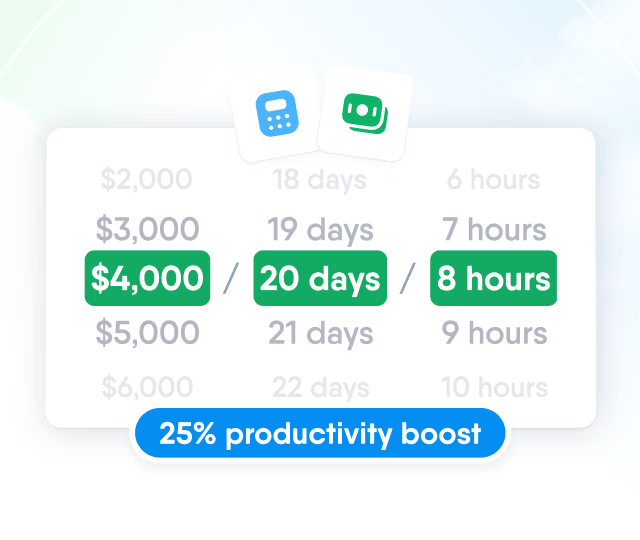
HR efficiency estimator
How does the HR efficiency estimator from PeopleForce work.
Calculate your impact



EU AI Act in HR
What the EU AI Act is, how it sorts AI systems by risk, why hiring and performance tools count as high-risk and when each set of rules applies
What is the EU AI Act?
The EU AI Act, formally Regulation (EU) 2024/1689, is the European Union's law on artificial intelligence. It sorts AI systems by the risk they pose to health, safety and fundamental rights and sets rules for each level, from outright bans to simple transparency duties. As a regulation, it applies directly in every member state without being transposed into national law. The current consolidated text, which includes the changes made by Regulation (EU) 2026/1744 (the Digital Omnibus on AI), is published on EUR-Lex.
For HR, the Act matters because the uses it treats most strictly include hiring and people management. Using artificial intelligence in HR to screen CVs or evaluate performance is therefore an HR compliance question as well as a technology choice.
Risk levels under the AI Act
Risk level | What it covers | Examples in HR | What applies |
|---|---|---|---|
Unacceptable | Practices banned by Article 5 | Recognising employees' emotions at work, except for medical or safety reasons; biometric categorisation to infer traits such as political opinions or sexual orientation | Prohibited |
High | Uses listed in Annex III, including point 4: employment and workers' management | Targeting job ads, filtering applications and evaluating candidates; decisions on promotion or termination; allocating tasks based on behaviour or personal traits; monitoring and evaluating performance | Risk management, data quality, documentation and human oversight, with duties for the provider and for the employer using the system |
Limited (transparency) | Article 50 | An HR chatbot that answers employee questions; AI-generated text, images or audio | People must be told they are dealing with AI, and some generated content must be marked |
Minimal | All other AI systems | Spell-checking, drafting a message, suggesting meeting times | No specific obligations beyond AI literacy |
Not every AI tool used in recruitment is automatically high-risk. Under Article 6(3), a system listed in Annex III is not considered high-risk if it does not materially influence the outcome of a decision, for example when it performs a narrow procedural task or prepares an assessment that a person then carries out. A system that profiles people always stays high-risk, which is why tools that rank or score candidates in AI recruiting usually remain in this category.
Who the AI Act applies to in HR
The Act separates providers, who develop an AI system and place it on the market, from deployers, who use it under their own authority. A company that switches on AI screening in its applicant tracking system is a deployer, and the software vendor is the provider. Most duties for high-risk systems sit with providers, but employers that deploy them have their own:
- use the system in line with the provider's instructions for use;
- assign human oversight to people with the competence, training and authority to act on what the system produces;
- inform workers' representatives and the affected employees before a high-risk AI system is used at the workplace.
One duty applies to every AI system, not only high-risk ones: under Article 4, providers and deployers take measures to build the AI literacy of the staff who operate AI on their behalf. The Act also reaches beyond the EU. Article 2(1)(c) covers providers and deployers based outside the Union when the output of their AI system is used in the EU. Data protection rules such as the GDPR apply alongside it.
Key dates
Date | What applies |
|---|---|
2 February 2025 | General provisions, including AI literacy, and the bans on prohibited practices |
2 August 2025 | Rules for general-purpose AI models, governance and penalties |
2 August 2026 | Most remaining provisions, including the transparency duties of Article 50 |
2 December 2027 | Requirements for high-risk systems listed in Annex III, including hiring and people management |
2 August 2028 | Requirements for high-risk AI built into products covered by EU product legislation (Annex I) |
The high-risk dates were set by Regulation (EU) 2026/1744. Before that amendment, the Annex III requirements were due to apply from 2 August 2026. Fines reach up to EUR 35 million or 7% of worldwide annual turnover for prohibited practices, and up to EUR 15 million or 3% for breaches of most other obligations, whichever is higher. For SMEs, the lower of the two amounts applies.
What the AI Act means for an HR team
- List every AI feature in your HR tools, including those built into software you already use, and what each one is used for.
- Sort each use by risk level. Screening, ranking and performance evaluation usually fall under Annex III.
- Ask vendors for the instructions for use and documentation that providers of high-risk systems have to supply.
- Decide who reviews AI output and has the authority to overrule it, and plan how employees and their representatives will be informed.
- Train the people who work with AI tools.
The EU AI Act and UK employers
The UK is outside the EU, but the Act can still reach British companies through Article 2(1)(c). That happens when a UK employer uses an AI system whose output is used in the EU, for example to screen candidates for a team in Ireland or Germany, or when a UK vendor supplies AI tools to customers in the EU. A UK company that hires and manages people only in the UK and uses AI output only there is generally outside its scope.
At home, the UK has no AI-specific law. AI used in hiring and people management falls under existing rules: UK GDPR, whose provisions on automated decision-making were updated by the Data (Use and Access) Act 2025, and the Equality Act 2010, which applies to discriminatory outcomes however they are produced. The ICO and sector regulators oversee AI within their remits, and the government has not committed to a dedicated AI bill.
AI in PeopleForce
In PeopleForce AI, each AI feature is switched on separately: AI CV parsing is a company setting, AI scoring of candidates is turned on for each vacancy, and AI help with writing performance reviews is turned on for each review cycle. When AI scoring is on, every verdict comes with a written reason for each criterion the recruiter set. Name, contact details, gender, date of birth and desired compensation are not sent to the model, and a verdict never moves or rejects a candidate on its own: the decision on the next stage or a rejection stays with the recruiter. This keeps a person in charge of each hiring decision and shows how every AI verdict was reached.
Frequently asked questions
Does the EU AI Act apply to companies outside the EU?
Yes, in some cases. It applies to providers and deployers based outside the EU when the output of their AI system is used in the EU, for example when a company abroad uses AI to assess candidates for a role in an EU office. If AI output is used only outside the EU, the Act generally does not apply, although local data protection and equality law still does.
Is every AI tool used in HR high-risk?
No. High risk covers the uses listed in Annex III, such as selecting candidates, deciding on promotions or terminations and evaluating performance. A tool that drafts a job ad or answers employee questions usually falls under the transparency or minimal risk levels, and a listed tool can fall outside high risk when it does not materially influence the decision and does not profile people.


Let us show you what's possible
From Core HR to advanced workforce analytics — see the platform saving 80 hours a month for teams just like yours. Fully tailored to your workflow.