
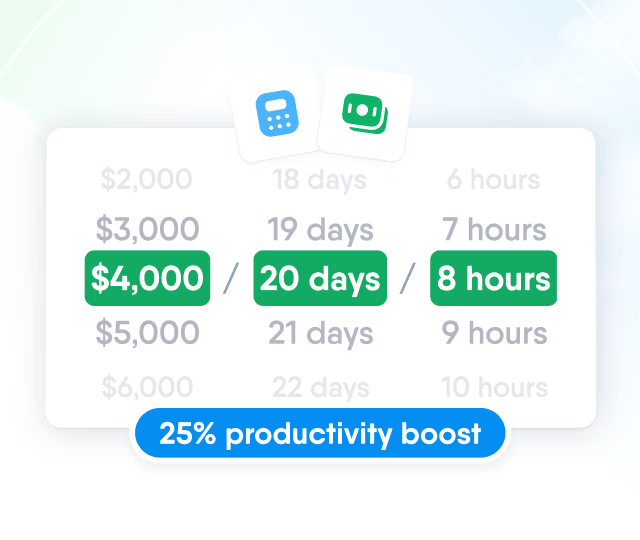
HR efficiency estimator
How does the HR efficiency estimator from PeopleForce work.
Calculate your impact



Prorated salary
What a prorated (pro rata) salary is, when it applies, how the calendar-day and working-day methods differ and how to calculate pay for a part month
What is a prorated salary?
A prorated salary, also called a pro rata salary, is the share of a full salary paid for the part of a pay period a person actually worked or was employed. It applies when someone joins or leaves mid-month, takes unpaid leave, gets a pay change during the period or works part-time against a full-time rate.
The principle is simple: pay follows time. What changes the figure is the divisor, meaning whether the month is counted in calendar days, working days or hours. The method should be written into the contract or payroll policy and applied in the same way to everyone in a pay period.
How to calculate a prorated salary
The examples use a monthly salary of £3,000 in a 30-day month with 22 working days. The person joined part-way through and was employed for 20 calendar days, 15 of them working days.
| Method | Formula | Example |
|---|---|---|
| Calendar days | Salary × calendar days employed ÷ calendar days in the month | £3,000 × 20 ÷ 30 = £2,000 |
| Working days | Salary × working days employed ÷ working days in the month | £3,000 × 15 ÷ 22 = £2,045.45 |
| Hours | Salary × hours worked ÷ scheduled hours in the month | £3,000 × 120 ÷ 176 = £2,045.45 |
| Part-time against a full-time rate | Full-time salary × contracted hours ÷ full-time hours | £30,000 × 24 ÷ 37.5 = £19,200 a year |
The two day-based methods rarely give the same figure, and in February or in a month with several public holidays the gap is wider. Neither is wrong. What matters is that one method is chosen, documented and used for every joiner, leaver and unpaid absence.
When salary is prorated
- A new hire starts after the first day of the pay period.
- An employee leaves before the period ends.
- Someone takes unpaid leave or has another unpaid absence.
- Salary changes mid-period, so each rate is paid for its own days.
- A part-time employee is paid a share of the full-time equivalent rate.
Prorated salary in the UK
UK law does not set one formula for part-month pay. The method comes from the employment contract, and where the contract is silent employers apply one rule consistently, by calendar days or by working days. Two limits apply whatever the method. Pay for the hours worked in the pay reference period must not fall below the National Minimum Wage, and part-time workers must not be treated less favourably than comparable full-time workers, which is why part-time pay and holiday entitlement are set pro rata to full-time terms. The resulting gross pay and deductions have to be shown on the payslip.
Prorated salary in PeopleForce
In PeopleForce Payroll, proration is a pay rule set once for each payroll cycle: by calendar days or by working days. Every payroll run then applies it to everyone in the cycle. Base pay starts on the hire date and stops on the termination date, and approved unpaid leave and public holidays feed into the calculation. For each person the run shows the rate, its hourly equivalent, expected and worked hours, leave and public holidays behind the amount, so a prorated figure can be traced back to its inputs. The run works out gross pay and exports to Excel or CSV for the accountant or payroll system that calculates taxes and net pay.
Frequently asked questions
Calendar days or working days: which method is better?
Calendar days treat every day of the month alike, so the result does not depend on where weekends and public holidays fall, and the method is easier to explain. Working days tie pay to the days the person was scheduled to work, but the value of one day changes from month to month. Choose one method for the company or the payroll cycle and keep to it.
Are bonuses and allowances prorated too?
Fixed monthly allowances are usually prorated in the same way as base salary. For an employee bonus, the scheme rules decide: some schemes pay in proportion to the time worked in the bonus period, others require the person to be employed on the payment date.


Let us show you what's possible
From Core HR to advanced workforce analytics — see the platform saving 80 hours a month for teams just like yours. Fully tailored to your workflow.