
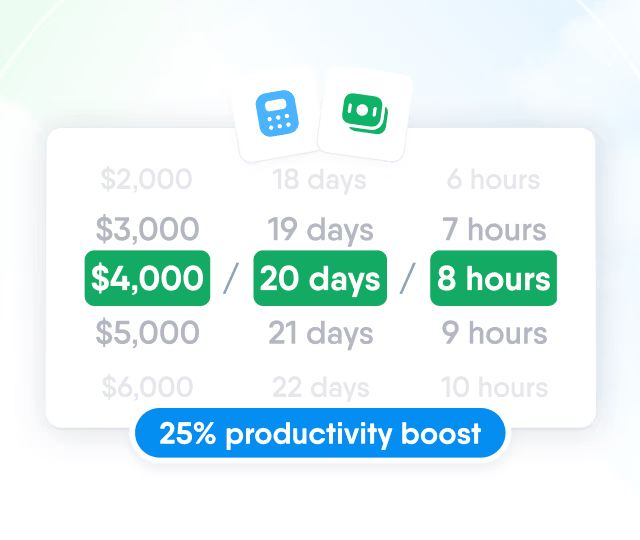
HR efficiency estimator
How does the HR efficiency estimator from PeopleForce work.
Calculate your impact



Shift work
Shift work is a schedule in which employees work in rotating or fixed teams to cover hours beyond a standard working day, including evenings, nights and weekends.
Shift work is any arrangement where employees work in successive teams so that an operation runs beyond a single standard working day. Instead of everyone working nine to five, staff are divided into shifts that cover mornings, evenings, nights, weekends or a full 24-hour cycle. It is the norm in manufacturing, healthcare, logistics, retail, hospitality, security, transport, contact centres and any support team with follow-the-sun coverage.
The defining feature is not long hours but changing hours: the same role is performed at different times of day by different people, according to a published pattern.
Common shift patterns
- Fixed shifts. Each person always works the same block, for example permanent nights. Predictable and easy to staff for, but the night team can drift into a separate culture.
- Rotating shifts. Teams move through mornings, afternoons and nights on a cycle. Fairer in principle, harder on the body; forward rotation (morning to afternoon to night) suits circadian rhythms better than backward rotation.
- Continental and DuPont patterns. Long-standing 24/7 rotations built around 8-hour or 12-hour shifts that give blocks of several days off in a row.
- Split shifts. Two separate blocks in one day with a long unpaid gap, common in restaurants and transport, and often the most disliked arrangement.
- On-call and standby. Not an actual shift until the call comes, but restricted time all the same, and in several jurisdictions partly payable.
Patterns are often confused with compressed work weeks and flexible working hours. The difference is who controls the clock: in shift work the employer sets the times and coverage is the constraint.
The rules that apply to shift and night work
Night work carries extra protection almost everywhere, so the schedule has to be built around local labor laws rather than convenience.
The EU Working Time Directive caps night work at an average of 8 hours per 24 and requires 11 hours of daily rest and a weekly rest period. In Poland, night time is 8 hours falling between 21:00 and 7:00, and each hour worked in it carries a premium of 20 % of the hourly minimum wage. In Ukraine, night time runs from 22:00 to 6:00, night hours are paid at a premium of at least 20 % of the rate, shift rosters must be agreed with the employee representatives and communicated in advance, working two shifts in a row is prohibited, and rest between shifts must be at least twice the length of the shift worked. In Argentina, the night shift runs from 21:00 to 6:00 and is limited to 7 hours, with each night hour counting as 1 hour 8 minutes when mixed with day work. Pregnant employees, young workers and, in many countries, parents of small children have the right to refuse night work.
Managing the human side
Shift work sleep disorder is a recognised condition, and rotating night work is associated with higher fatigue, error and turnover rates. The practical levers are mostly scheduling ones: publish rosters far in advance so people can plan their lives, rotate forward rather than backward, avoid quick returns where an evening shift is followed by an early morning, and keep consecutive night shifts to a small number with proper recovery afterwards.
The second lever is inclusion. Night and weekend teams miss all-hands meetings, training and informal news, which shows up later in engagement scores and in turnover. Recording the same information asynchronously, rotating meeting times and giving shift teams a real channel to raise problems costs little and changes retention. Watch the leading indicators too: rising sickness absence, unused leave and presenteeism usually appear in the data before anyone resigns.
Shift work in PeopleForce
Working hours in PeopleForce start with working patterns. A pattern sets the hours, break hours and start time for each day of the week, and is assigned per employee, so a night team and an office team live under different patterns in the same company. Attendance policies then define how time is recorded and approved: employees clock in and out in PeopleTime, breaks are logged inside the shift, and the system blocks overlapping entries and flags shifts that run past the expected duration.
Premium hours are configured as special hour types: a named window such as 22:00 to 06:00 with its own compensation multiplier and a code that becomes a separate column in the payroll export, plus overtime types tied to working days, non-working days or public holidays. That way night, weekend and holiday work are separated automatically rather than recalculated by hand each month. Approved hours land in the timesheet, absences from leave tracking appear in the same view so gaps in coverage are visible early, and HR analytics compares overtime and absence across shifts.


Let us show you what's possible
From Core HR to advanced workforce analytics — see the platform saving 80 hours a month for teams just like yours. Fully tailored to your workflow.