
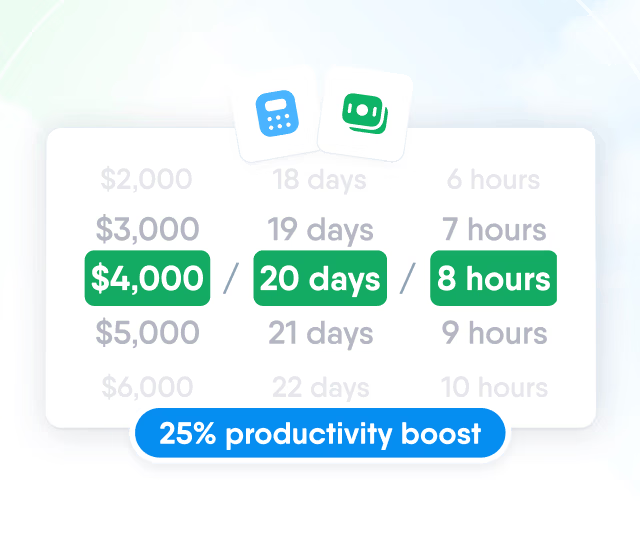
HR efficiency estimator
How does the HR efficiency estimator from PeopleForce work.
Calculate your impact



Job description: templates and example duties for Ukraine and the UK

A job description defines the purpose, duties, authority, accountability and requirements of a role, not of a specific person. In Ukraine it takes the form of a formal posadova instruktsiia (job instruction) with seven fixed sections, approved by the director and signed by the employee. In the UK it is usually a shorter document used for hiring and performance, while the legally required minimum sits in the written statement of employment particulars.
In both countries the practical point is the same: a written job description is the best evidence of what was expected from an employee. Without it, a warning, a change of duties or a performance conversation rests on verbal agreements.
Key facts
Written for the role, not the person. The employee changes, the document stays.
Ukraine: seven sections, approved by the director, signed and dated by the employee. Mandatory for some roles, such as civil service and occupational safety.
UK: a job description is not a legal requirement, but the written statement of particulars must include the job title or a brief description of the work from day one.
One duty, one line. Start with a verb and avoid “assists with” and “participates in”.
Ukraine: the job instruction
For most private companies, the Ukrainian Labour Code does not directly require a job instruction for every role. The obligation is indirect: the employment contract covers work “defined by the agreement” (Article 21), an employer cannot demand work not covered by the contract (Article 31), and the employer must explain rights and duties before work starts (Article 29). If duties are not written down, the line between “his job” and “not his job” does not legally exist. For civil service, occupational safety roles and the person responsible for military records, a job instruction is mandatory.
Section | What it contains |
|---|---|
1. General provisions | Job title, department, reporting line, who appoints and dismisses, deputy during absence |
2. Tasks and duties | The purpose of the role and a complete list of duties. The most important section |
3. Rights | Access to information, signing authority, right to request resources and make proposals |
4. Responsibility | What the employee is accountable for: duties, data, confidentiality, safety rules |
5. Must know | Regulations, standards, methods and software needed for the job |
6. Qualification requirements | Education, experience, certificates, languages |
7. Working relationships | Who the employee exchanges information with, what they receive and pass on, and when |
The document is approved by the director with an “APPROVED” stamp or a separate order, and the employee signs and dates it before starting work. Adding new duties counts as a change to essential working conditions and requires two months' notice under Article 32. Rewording existing duties only needs a new version and a new signature.
Template: Ukrainian job instruction
APPROVED
Director of _______ LLC
_________ /______________/
___ ____________ ____
JOB INSTRUCTION
_______________________________
(job title, department)
1. General provisions
1.1. This job instruction sets out the tasks, duties, rights and responsibilities of the _______.
1.2. Appointment and dismissal are made by order of the director.
1.3. Reports directly to _______.
1.4. During absence, duties are performed by _______.
2. Tasks and duties
2.1. _______
2.2. _______
3. Rights
3.1. To receive the information and documents needed to perform duties.
3.2. To submit proposals to management.
4. Responsibility
4.1. For improper performance of duties, within the limits of labour law.
4.2. For disclosure of confidential information.
5. Must know
5.1. _______
6. Qualification requirements
6.1. Education: _______
6.2. Experience: _______
7. Working relationships
7.1. Receives from _______: _______ by _______.
7.2. Passes to _______: _______ by _______.
Read and received a copy:
_________ /______________/ ___ ____________ ____
UK: job descriptions and the written statement
UK law does not require a separate job description. What is required is a written statement of employment particulars, given on or before the first day of work, which must include the job title or a brief description of the work (Employment Rights Act 1996, section 1). Most employers still use a fuller job description for hiring, onboarding and performance reviews, often alongside a person specification.
Unlike in Ukraine, a UK job description often ends with a flexibility clause such as “any other reasonable duties as required”. Courts generally accept it, provided the duties stay within what is reasonable for the role. A fundamental change to the job still needs the employee's agreement, because it changes the contract.
Template: UK job description
JOB DESCRIPTION
Job title: _______
Department: _______
Reports to: _______
Direct reports: _______
Location and working pattern: _______
Purpose of the role
_______
Key responsibilities
1. _______
2. _______
3. _______
Key relationships
Internal: _______
External: _______
Person specification
Essential: _______
Desirable: _______
This job description reflects the main duties of the role. The postholder may be asked to carry out other reasonable duties in line with the role.
Ukraine vs UK at a glance
Criterion | Ukraine | United Kingdom |
|---|---|---|
Legal status | Indirectly required; mandatory for some roles | Not required; written statement of particulars is |
Format | Seven fixed sections, approved by the director | Flexible format, often with a person specification |
Employee signature | Required with date, before work starts | Common practice, not required |
“Other duties” clause | Must be limited to the role (Article 31) | Accepted if duties are reasonable for the role |
Adding new duties | Two months' notice (Article 32) | Employee agreement for fundamental changes |
How to write duties
- Start with a verb. “Prepares”, “checks”, “approves”: an action, not a state.
- One duty, one line. If a sentence has two “ands”, it is two duties.
- Add the object and frequency. Not “handles reporting” but “prepares the monthly report by the 5th of the following month”.
- Check it is measurable. If you cannot say whether it was done, rewrite it.
Weak wording | Clear wording |
|---|---|
Contributes to team efficiency | Prepares the monthly team performance report and sends it to the manager by the 5th |
Assists with recruitment | Runs initial phone screens and prepares a shortlist for the hiring manager |
Responsible for documentation | Prepares contracts and contract changes on the day the decision is made |
Example duties by role
Accountant
- Records transactions in the ledger on the day source documents are received.
- Checks invoices for required details and returns incorrect ones.
- Prepares payments and monitors tax and social contribution deadlines.
- Prepares monthly bank reconciliations.
- Takes part in stocktakes and records the results.
HR officer
- Prepares contracts, changes and termination documents in line with employment law.
- Maintains personnel files and employee records.
- Keeps absence and leave records up to date.
- Issues employment certificates and references within three working days of a request.
- Prepares statutory HR reports.
Team manager
- Plans the team's work and assigns tasks.
- Holds regular one-to-ones with each team member.
- Takes part in hiring and onboarding new starters.
- Runs performance reviews and sets goals for the next period.
- Manages the team budget.
Common mistakes
Writing the document around a specific person and their habits.
Copying duties from the internet that do not match the real job.
Job title differs from the contract or the staff schedule.
Signature without a date, so it is impossible to prove when the employee knew their duties.
Not reviewing the document for years while processes and tools have changed.
Where to keep job descriptions
The main operational problem is not writing job descriptions but tracking who signed which version and when. In Core HR this is handled with document templates: the job description is generated with the employee's and role's details, stored in their profile and sent for signature. The system records who it was sent to, who opened it and who signed it.
Documents are signed with an electronic signature, and the step can be built into onboarding, so every new starter reads their duties before day one. More on the concept in our glossary entry on the job description.
Frequently asked questions
Is a job description a legal requirement?
In the UK, no, but the written statement of particulars must include the job title or a brief description of the work. In Ukraine, it is indirectly required and mandatory for some roles.
Who writes the job description?
Usually the line manager together with HR. In Ukraine, the director approves it.
Can an employer change the job description?
Minor clarifications, yes. In Ukraine, adding new duties requires two months' notice. In the UK, a fundamental change needs the employee's agreement.
Is “any other reasonable duties” allowed?
In the UK, generally yes, if the duties are reasonable for the role. In Ukraine, the clause should be limited to tasks within the role, because an employer cannot demand work outside the contract.
How often should a job description be reviewed?
At least once a year and whenever processes, tools or team structure change.
The PeopleForce editorial team creates and refines content on people management, recruiting, team development and HR technology. Every article goes through an editorial review for accuracy, relevance and clarity. We rely on verified sources, industry research, hands-on experience and PeopleForce’s own analytics, including anonymized data, to give HR professionals, managers and business owners useful, reliable information.


One login. Every HR tool you'll need.
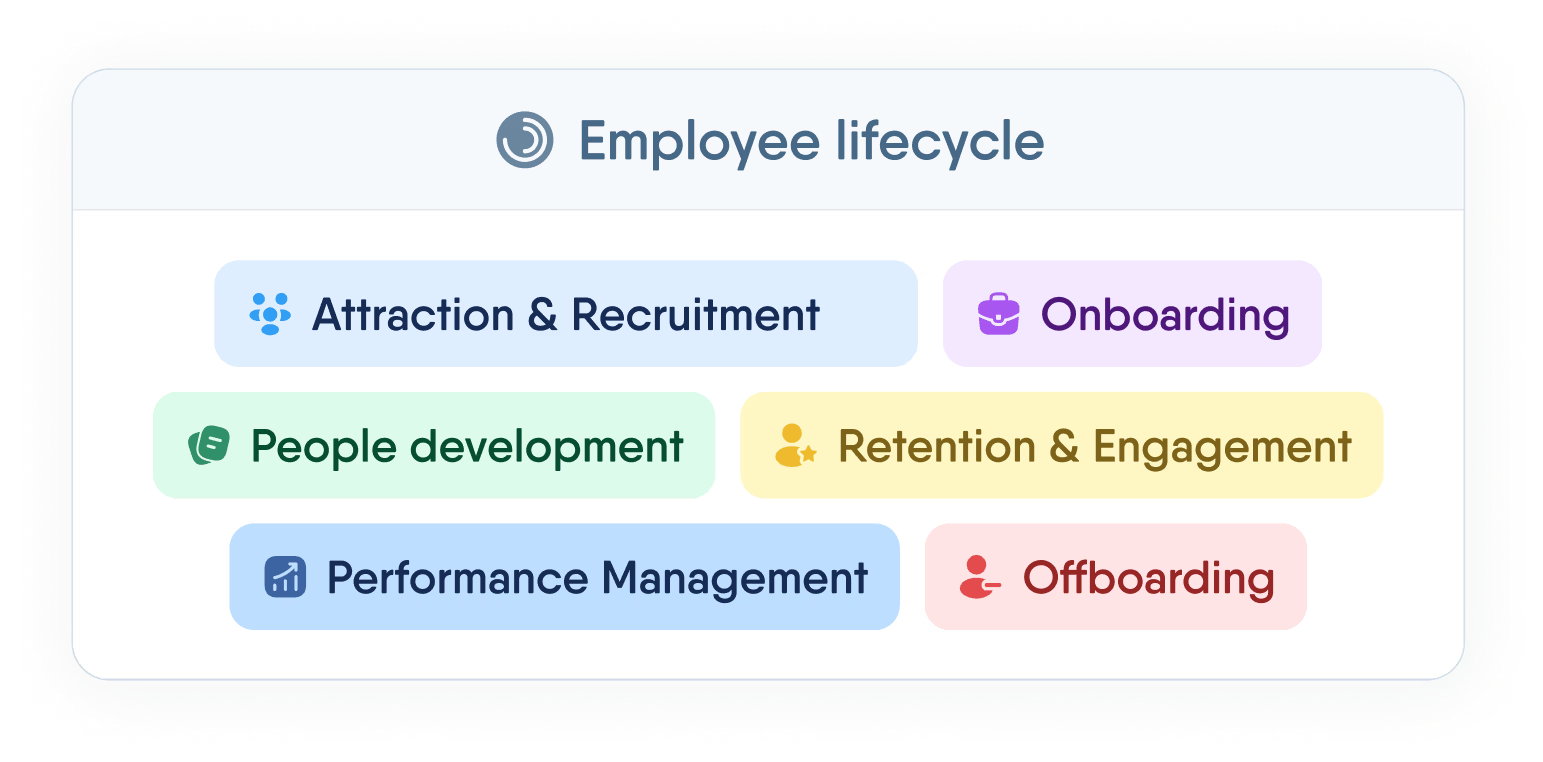
Manage the full employee lifecycle — from first interview to final offboarding — without switching tabs or losing data.
Recent articles
Employee KPIs: how to set them, measure them and keep motivation intact
What a KPI is, how to set KPIs in five steps, 30 examples by department, weighted achievement calculation and how to link KPIs to bonuses.
Soft skills vs hard skills: the difference and how to assess them
The difference between soft and hard skills, 30 soft skills explained, hard skills by profession and 18 behavioural interview questions.
Job offer: what to include, template and examples for Ukraine and the UK
Legal status of a job offer in Ukraine and the UK, what to include, a template, examples by role type and negotiation tips.