
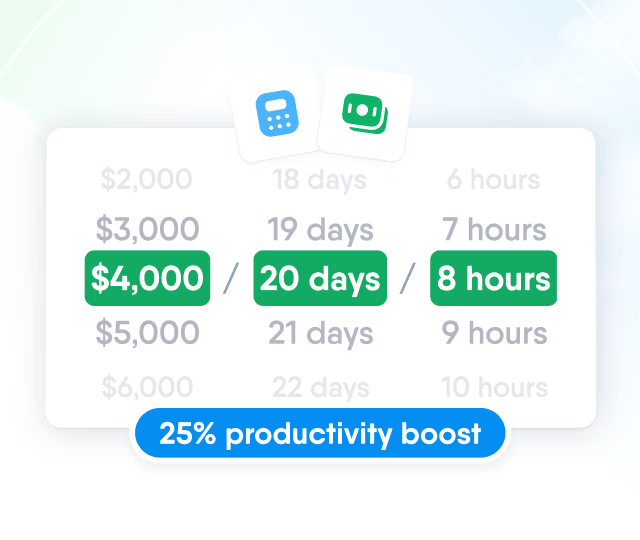
HR efficiency estimator
How does the HR efficiency estimator from PeopleForce work.
Calculate your impact



Employee feedback
What employee feedback is, which types exist, how to give it so that it changes something and where it sits between one-to-ones and performance reviews
What is employee feedback?
Employee feedback is information given to a person about their work or behaviour so that they know what to keep doing and what to change. It can come from a manager, a colleague, a direct report or a client, and it can be positive or constructive.
Feedback is not a performance review and not a disciplinary step. A review sums up a period and usually affects a rating or pay, while feedback is a short, specific message given close to the event. Given regularly, it becomes continuous feedback, and when people offer it to each other without being asked, the company has a feedback culture.
Types of employee feedback
| Type | What it is | When to use it |
|---|---|---|
| Positive (reinforcing) | Names what worked and why it mattered | Right after a good result, so the behaviour is repeated |
| Constructive (corrective) | Describes the gap between what was expected and what happened, and what to change | As soon as possible after the event, in private |
| Upward | From a direct report to their manager | In one-to-one meetings and surveys |
| Peer | Between colleagues at the same level | After shared projects, on request |
| 360-degree feedback | Structured input from the manager, peers and direct reports at once | During review cycles |
| Formal | Written into a performance review | At the end of a cycle |
How to give feedback to employees
- Give it soon: within days of the event, while both sides remember the details.
- Describe a fact, not a trait: ‘the report arrived two days after the deadline’, not ‘you are unreliable’.
- Explain the impact on the team, the client or the result.
- Ask for the other person's view before proposing a solution.
- Agree on one next step and when you will come back to it.
- Praise with the same precision: ‘thanks, good job’ teaches nothing.
- Write it down, so the next one-to-one or review rests on examples and not on memory.
Models such as SBI (Situation, Behaviour, Impact), STAR and GROW put these steps into a fixed order. An example in SBI: ‘In Tuesday's client call (situation) you answered the pricing question before the client had finished (behaviour). They did not get to raise their main concern and we needed a second call (impact).’
Employee feedback and UK practice
UK employment law does not regulate everyday feedback, but it matters once performance becomes a formal issue. The Acas Code of Practice on disciplinary and grievance procedures expects employers to raise problems with the employee, give them a chance to improve and keep written records before taking formal action. Regular, documented feedback shows that the person knew what was expected long before a performance improvement plan or a written warning. Written feedback about a named person is also personal data under the UK GDPR, so the employee can ask to see it. It belongs in a system with access rules, not in private notes or chat threads.
Employee feedback in PeopleForce
In PeopleForce Perform, employees with the right permission can give feedback to any colleague they can see in the system or request it about themselves, and managers can also request it about their direct reports. Each note is visible either to the person and their manager or to the manager only. The author's name is always shown, so feedback is never anonymous. The person is notified about feedback shared with them, and all notes are collected on their Performance tab, newest first, which gives managers concrete examples for one-to-ones and performance reviews. Requests that are still waiting for an answer appear on the Home page. In performance reviews, the AI Writing Coach can check a draft answer against a framework such as SBI or STAR and point out what is missing, without rewriting the text.
Frequently asked questions
What is the difference between feedback and a performance review?
Feedback is a short message about one situation, given throughout the year. A performance review sums up the whole period, compares results with goals and often affects pay or promotion. A good review contains no surprises, because it is built from feedback the person has already heard.
Should employee feedback be anonymous?
Anonymity suits questions about the company as a whole, as in a pulse survey. Feedback about one person's work is more useful when it is signed: the recipient can ask follow-up questions and the author takes responsibility for the wording.


Let us show you what's possible
From Core HR to advanced workforce analytics — see the platform saving 80 hours a month for teams just like yours. Fully tailored to your workflow.