
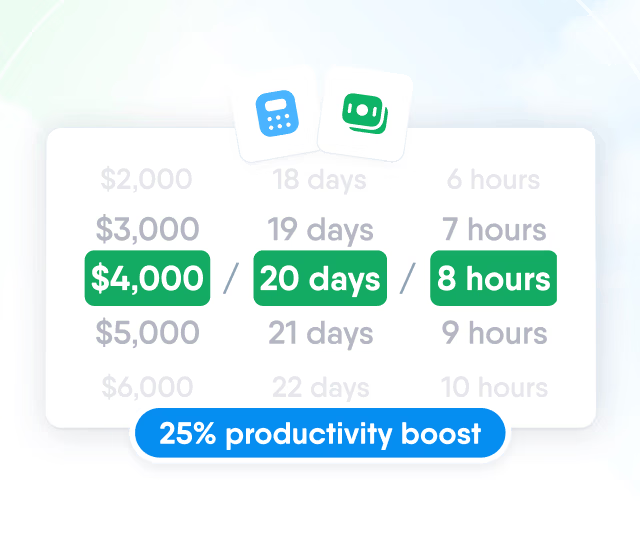
HR efficiency estimator
How does the HR efficiency estimator from PeopleForce work.
Calculate your impact



Recruitment marketing
Recruitment marketing is everything a company does to attract and interest candidates before they apply: career site, job ads, content, channels and the measurement behind them.
Recruitment marketing is the work of attracting candidates before they apply. It borrows the methods of marketing (audience definition, channels, messaging, measurement) and points them at a hiring problem rather than a sales one. Everything from the moment someone submits an application onward is recruitment; everything before it is recruitment marketing.
It exists because the old model stopped working. Posting a vacancy and waiting assumes candidates are looking. For most senior and technical roles they are not, and the ones who are looking have twenty tabs open. Recruitment marketing is the answer to a market where the company has to be interesting first and hiring second.
How it differs from employer branding
The two are constantly used interchangeably, and the distinction is practical rather than academic. Employer brand is what people already believe about working for you. It is slow, it is largely built by the experience of current and former employees, and you influence it rather than control it. Recruitment marketing is campaign work: a defined audience, a defined message, a channel, a budget and a result you can count this quarter.
The brand sets the ceiling on what the marketing can achieve. If the employee value proposition is weak or untrue, better campaigns bring more people to a decision they will make against you, faster and at higher cost.
What it is made of
- The career site. The one asset you own. Everything else rents attention and sends it here, so a slow career site with a ten-field application form cancels the spend upstream.
- Job ad copy. The single highest-leverage piece and the one nobody owns. Most job ads are internal job descriptions pasted into a public field.
- Distribution. Job boards, aggregators, professional networks, niche communities. The mix is local: what works in Warsaw is not what works in Buenos Aires.
- Content. Engineering blog posts, team interviews, honest looks at how the work is done. Slow to build and the main way to reach people who are not looking yet.
- Employee advocacy and referrals. A post by an engineer outperforms the company account almost every time, and an employee referral program is the cheapest channel most companies under-use.
- Talent pool nurturing. Keeping in contact with people who are already interested but not available yet.
- Paid. Useful for volume and for hard geographies, and the fastest way to waste a budget without the tracking below.
Measuring it without vanity metrics
Followers, impressions and career site sessions describe activity. The numbers that describe results run down the funnel: applications per channel, the share of applications that pass screening, cost per qualified applicant rather than per applicant, and finally source of hire. A channel producing three hundred applications of which none pass screening is more expensive than a channel producing eight of which three are hired, regardless of what the cost per click says.
Two further numbers are worth tracking because they connect marketing to the rest of hiring. Application completion rate, which usually reveals a form problem rather than an interest problem, and retention of the people hired through each channel, which is where a promise that the job did not match shows up as early attrition.
Where it goes wrong
The most common failure is posting everywhere and measuring nothing, which produces a bill and no information. The second is a campaign that promises a culture the company does not have; it works at the application stage, then reverses itself at ninety days when people leave and tell others why. The third is treating recruitment marketing as something that only runs when a role opens, which means starting from zero every time, at the exact moment you have the least time. And the fourth is running it entirely separately from the recruiting funnel, so nobody can connect a campaign to a hire and the budget conversation has no evidence in it.
Recruitment marketing in PeopleForce
Distribution runs as a campaign against a vacancy in PeopleRecruit rather than as a set of manual postings. A campaign holds channels, each with its own publication state, so a posting that failed or lost authorisation shows as errored or unauthorised instead of silently not existing, and each channel carries its own duration, with thirty days as the default. The integrated channels cover the boards that matter in the target markets, including Work.ua, Robota.ua, Djinni and HeadHunter, plus the VONQ network for reaching boards beyond those. Publishing and unpublishing are handled per channel, and a campaign with no active channel left goes offline on its own.
The measurement side depends on attribution being recorded at the point of entry. Every candidate carries a source, sources are a managed list rather than free text, and candidates arriving through the multiposting channels are attributed automatically. The career site can run on your own domain, and the application form fields are configured per vacancy, which is the lever for the completion-rate problem above. From there the funnel reports in HR analytics show not just applications per source but what happened to them, which is the difference between reporting traffic and reporting hires.


Let us show you what's possible
From Core HR to advanced workforce analytics — see the platform saving 80 hours a month for teams just like yours. Fully tailored to your workflow.