
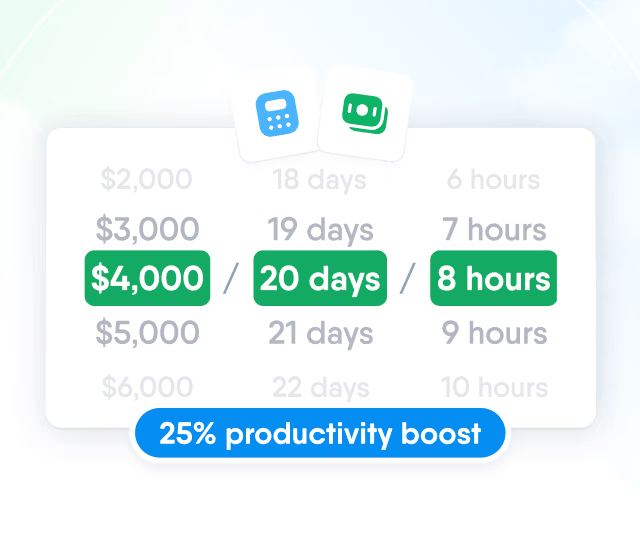
HR efficiency estimator
How does the HR efficiency estimator from PeopleForce work.
Calculate your impact



Remote work
What remote work is, the models companies use, benefits and risks, what a remote work policy must cover, how labor law treats it in different countries and how HR manages distributed teams
Remote work is a working arrangement in which employees perform their jobs outside the employer's premises, usually from home or any location of their choice, connected to the team through digital tools rather than a shared office. It differs from hybrid work, where people split the week between office and home, and from telecommuting in its older sense of occasionally working from home; a fully remote role has no expectation of physical presence at all. What began as an exception for a few professions became a standard model after 2020, and for a growing share of knowledge workers it is now a condition of accepting a job rather than a perk.
Models of remote work
- Fully remote. The whole company or team works without an office; meetings, documentation and decisions happen online by design.
- Remote-first. The company keeps offices but treats remote as the default: any process that works only in the room is considered broken.
- Hybrid. A fixed or flexible split between office and home, described in detail in hybrid workplace organization.
- Remote-allowed. Office-centric culture where individuals may work from home with manager approval; the most common and the least deliberate model.
- Distributed across borders. Employees in several countries, which adds employer-of-record, tax residency and local labor law questions to the operational ones.
Benefits and risks for the employer
Remote work widens the talent pool beyond commuting distance, lowers real estate cost, and is consistently rated by employees as one of the most valued benefits, which shows up in retention and in the share of candidates who accept offers. The risks are equally concrete: burnout from blurred boundaries, isolation and weaker onboarding for new hires, uneven visibility that quietly favors people who are physically near managers, and security and data protection exposure when work happens on home networks and personal devices. None of these are arguments against remote work; they are the list of things a remote policy has to address explicitly.
What a remote work policy should cover
Eligibility by role and how requests are made and approved, in line with flexible working request rules where they apply. Working hours, core hours for overlap across time zones and the right to disconnect. Where people may work from, including whether working from another country is allowed and for how long. Equipment, internet and home office reimbursement. Security requirements: VPN, device encryption, handling of personal data under data protection rules. Health and safety obligations, which in many countries still apply to the home workplace. Communication norms: which channels are for what, response time expectations, meeting-free blocks. Performance expectations based on outcomes rather than hours online, and how one-on-one meetings and performance reviews compensate for the lack of hallway feedback.
Remote work and the law
Most jurisdictions have moved remote work from informal practice into labor law. In the European Union the Transparent and Predictable Working Conditions Directive requires the place of work, or the freedom to choose it, to be stated in writing, and several member states, Poland among them, have dedicated remote work chapters in their labor codes covering employer cost reimbursement, occupational safety at home and the employee's right to request remote work. Ukraine distinguishes remote work from home-based work in its Labor Code and requires a written agreement for both. Argentina's teleworking law gives remote employees the right to disconnect and to return to on-site work. The recurring themes everywhere are the same: the arrangement must be documented, working time must still be recorded, and the employer keeps its duty of care for the employee's health and data even when it does not control the workplace.
Remote work in PeopleForce
Distributed teams run on the same PeopleForce Core HR data as office teams, so remote work is a setting rather than a separate process. Each employee has a work type and a location on their profile, which lets HR see who works remotely, where, and under which legal entity, and filter the employee directory and org chart by either. A request form lets an employee ask to change work type or location with a manager approval flow, and the change is recorded with an effective date. Leave requests and approvals, time tracking, one-on-one agendas, pulse surveys and eNPS all work from the browser, the mobile app or Slack, so managers get the signal on engagement and workload they would otherwise pick up in the office, and onboarding workflows deliver the same first-week experience to a hire who never sets foot in a building.


Let us show you what's possible
From Core HR to advanced workforce analytics — see the platform saving 80 hours a month for teams just like yours. Fully tailored to your workflow.