
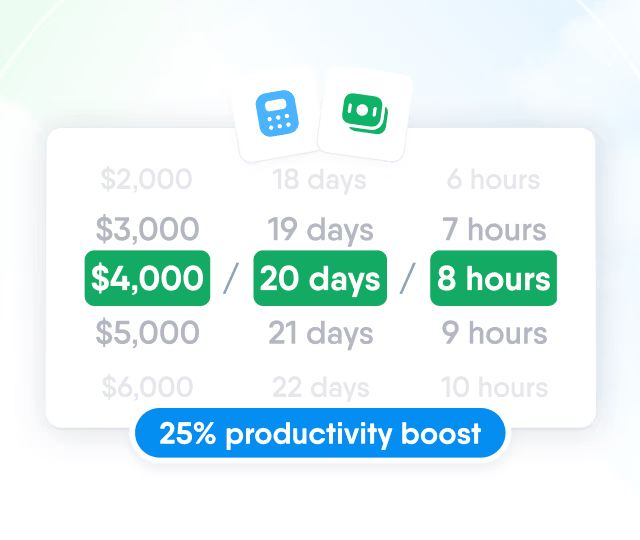
HR efficiency estimator
How does the HR efficiency estimator from PeopleForce work.
Calculate your impact



Skills-based hiring
Skills-based hiring selects candidates on demonstrated ability rather than on proxies such as degrees, years of experience or the name of a previous employer.
Skills-based hiring means selecting candidates on demonstrated ability to do the work, rather than on proxies for that ability. The proxies it replaces are familiar: a degree requirement, a minimum number of years, the brand of a previous employer, a job title that sounds adjacent. Those signals are cheap to filter on and only loosely related to performance, which is the whole argument.
It is not the same as lowering the bar. A skills-based process usually asks candidates to do more, not less: the evidence it wants is a work sample, a structured answer or a test result, which is harder to produce than a CV.
Why the proxies are weak
Years of experience predicts performance poorly once someone is past the first couple of years in a field, because the tenth year is often the first year repeated ten times. Degree requirements filter on who could afford and access education as much as on capability, which is why removing them widens the pool without lowering the standard, as long as something real replaces them. And the unstructured interview, which is what most companies fall back on, is among the weakest selection methods there is while feeling like the strongest, because unconscious bias and the halo effect are invisible from the inside.
What it looks like in practice
- Define the role in skills, not in a profile. Competency mapping turns must-have into something checkable: not strong communicator but can write a client-facing incident summary a manager would send unedited.
- Cut the filters that are not requirements. If nobody can explain what the degree or the eight-year minimum is protecting against, it is a habit rather than a criterion.
- Use a work sample close to the real job. Two hours of the actual work beats a puzzle, and a paid short task beats an unpaid long one.
- Make interviews structured. Same questions, same order, same rating scale for every candidate, which is what makes two candidates comparable at all. See structured interview.
- Score against evidence, then decide. Each interviewer records their assessment before hearing anyone else's, or the last loud opinion in the debrief wins.
Where it breaks
The most common failure is relabelling. The requirements list is renamed a skills profile, nothing else changes, and the degree filter is still in the ATS. The second is assessment sprawl: a take-home task that costs a candidate an entire weekend, added on top of five interviews, which mostly selects for people with free time. The third is a skills list so abstract that nobody can score it, and the fourth is running all of this and then making the final call on gut feel anyway, which wastes everyone's effort and quietly restores every bias the process was built to remove.
There is also an honest limit. Skills-based hiring is strongest where the work produces observable output, and weakest where the role is judgement over long horizons, such as senior leadership. For those, structure helps but does not replace deep referencing and a genuine track record.
The internal half nobody runs
The same logic applies to promotion and internal moves, and this is where most companies stop being consistent: skills-based for external candidates, tenure-based internally. If a person outside can be hired for demonstrated ability without the degree, the person inside can be moved on the same basis. That is also what makes the skills gap visible as something you can close with upskilling and internal recruitment rather than only with hiring.
Running it in PeopleForce
The assessment side sits in test templates and scorecards in PeopleRecruit. A test template carries its own questions, a score per question and an optional time limit of up to 180 minutes, and it can be attached as an action in a recruiting workflow, so the assessment goes out automatically when a candidate reaches a given stage instead of when someone remembers. Results are stored on the candidate profile, so a decision can point at something rather than at an impression.
The interview side is covered by scorecards with defined questions: rating, select, multi-select, checkbox and text, each of which can be marked required so an incomplete assessment cannot be submitted. Every interviewer fills in their own scorecard with an overall rating from 1 to 5, and submitted ratings roll up into a candidate evaluation score on a 0 to 100 scale, which is what makes two candidates comparable across different interviewers. All of it exports to CSV with one column per question, which is how you check whether the criteria are actually being used or whether one interviewer rates everyone a four.


Let us show you what's possible
From Core HR to advanced workforce analytics — see the platform saving 80 hours a month for teams just like yours. Fully tailored to your workflow.