

HR efficiency estimator
How does the HR efficiency estimator from PeopleForce work.
Calculate your impact



Employment reference: structure and templates for Ukraine and the UK

An employment reference is a document in which an employer confirms someone's work history and, in many cases, comments on their performance. In Ukraine the formal version is called a kharakterystyka: an official document on company letterhead, written in the third person for courts, banks or other institutions. In the UK, a reference usually goes to a prospective employer and is often limited to dates and job title.
Both differ from a reference letter written by an individual manager in the first person. This guide covers the structure, ready-to-use templates for both countries, wording that works and what to leave out.
Key facts
Ukraine: a kharakterystyka is not mandatory, but on request the employer must issue an employment certificate with position, period of work and salary (Article 49 of the Labour Code).
UK: there is generally no legal duty to give a reference, except in regulated sectors such as financial services. Any reference given must be true, accurate and fair.
Facts must be verifiable: dates, roles, awards and disciplinary records come from HR files, not memory.
Personal data is shared with third parties with the employee's consent or at the request of an authorised body.
When you need a reference
Requests come from different directions, and the recipient decides which sections need detail. One generic reference for every purpose works badly.
Recipient | What to focus on |
|---|---|
Court | Discipline, attitude to duties, relationships at work, presence or absence of disciplinary action |
Bank or lender | Position, length of service, stability of employment |
Adoption or guardianship authorities | Reliability, personal qualities, working hours |
Prospective employer | Responsibilities, results, learning, teamwork |
University or scholarship | Self-organisation, development, career potential |
Internal use: promotion, award | Competencies, achievements, readiness for a new role |
Ukraine: the kharakterystyka
The Ukrainian Labour Code does not require employers to issue a kharakterystyka, but companies prepare them on request because refusing without reason damages the relationship and the employer brand. The document has seven sections: a header with company details, employee details, period of employment and position, duties and results, assessment of professional and personal qualities, awards and disciplinary action backed by orders, and the purpose of issue with the director's signature. One A4 page is enough.
Template: positive kharakterystyka
KHARAKTERYSTYKA
for _____________________ (full name), Sales Manager at _____________ LLC, born ____
_____________________ has worked at _____________ LLC since ____________ as a Sales Manager. Holds a degree in ____________ .
During this time, they have proved to be a qualified and responsible employee. They manage a client portfolio, prepare commercial proposals and handle deals from first contact to signed contract, and consistently meet their targets.
They follow internal regulations, are respected by colleagues and help new employees during onboarding. They completed training in ____________ .
No disciplinary action. Received a commendation for ____________ .
Issued for submission upon request.
Director ___________ (signature) ___________ (name)
___________ (date)
Template: kharakterystyka for a court
A court is interested in facts about conduct and attitude to duties, not an opinion on the case. The text should contain no reference to the circumstances of the case and no requests to the court.
KHARAKTERYSTYKA
for _____________________ (full name), born ____
_____________________ has worked at _____________ LLC since ____________ as ____________ .
During employment they have observed work discipline. No absences without good reason or breaches of internal rules have been recorded. No disciplinary action.
They are polite and composed with colleagues, and no conflicts involving them have been recorded. They carry out assigned tasks responsibly.
Issued for submission to ____________ (name of court).
Director ___________ (signature) ___________ (name)
UK: employment references
In the UK there is generally no legal obligation to give a reference. The exception is regulated work, such as roles under the FCA's Senior Managers and Certification Regime, where regulatory references are required. When a reference is given, the employer owes a duty of care to the former employee: the reference must be true, accurate and fair, and must not give a misleading impression, even if each statement is technically correct.
For that reason many UK employers give only a basic reference: dates of employment and job title, sometimes the reason for leaving. A detailed reference or a personal reference letter from a manager is more common for senior roles or when the employee asks for it.
Template: basic reference
Dear ____________,
Thank you for your request for a reference for _____________________ .
We can confirm that they were employed by _____________ Ltd from ____________ to ____________ as ____________ .
In line with company policy, we provide factual references only.
Kind regards,
____________ (name, HR)
____________ (date)
Template: reference letter from a manager
A strong reference letter rests on four parts: how long and in what capacity you worked together, what the person was responsible for, one or two concrete results, and a direct recommendation with your contact details. It is the same information a recruiter looks for during a reference check, only in writing.
Dear ____________,
As Head of ____________ at _____________, I worked with _____________________ for ____ years.
In the team they were responsible for ____________ . During that time they ____________ (a concrete result with numbers or facts).
I would particularly highlight ____________ (a strength with an example of behaviour).
I recommend _____________________ for the role of ____________ without hesitation and am happy to answer any questions.
____________ (name, job title)
____________ (phone, email)
Ukraine vs UK at a glance
Criterion | Ukraine | United Kingdom |
|---|---|---|
Is it mandatory | No, but an employment certificate is mandatory on request (Article 49) | No, except regulatory references in regulated sectors |
Typical recipient | Institutions: court, bank, authorities | Prospective employer |
Typical format | Letterhead, third person, assessment of qualities | Basic factual reference or manager's letter |
Legal standard | Facts backed by HR records and orders | True, accurate and fair; duty of care to the employee |
Signed by | Company director, often with the line manager | HR or the manager giving the reference |
Wording bank
The main problem with most references is a list of adjectives with no evidence. The rule is simple: every quality needs a behavioural example.
Quality | How to phrase it |
|---|---|
Reliability | “Delivers work on time without extra supervision”; “Flags risks to deadlines early” |
Learning | “Quickly mastered new tools and processes”; “Took on a wider remit within the first year” |
Teamwork | “Shares knowledge and supported new starters through onboarding” |
Resilience | “Maintains quality under tight deadlines and competing priorities” |
Initiative | “Proposed process improvements, several of which were adopted” |
Communication | “Handles written communication and negotiations with other teams clearly” |
What to leave out
Information unrelated to work: health, family circumstances, beliefs, background.
Wording that could be discriminatory on grounds of age, sex or any other protected characteristic.
Unresolved conflicts or internal investigations.
Disciplinary action that has expired or was never formally recorded.
Confidential business information: deal values, client names, internal metrics.
Salary, unless the recipient requires it and the employee agrees.
On personal data: in Ukraine, information about an employee is shared with third parties with their consent or at the written request of an authorised body. In the UK, references fall under UK GDPR, so keep a record of the employee's consent and of what was shared.
Checklist before signing
Dates and job titles checked against HR records.
Duties match the current job description.
Every assessment backed by an example or result.
Only documented awards and disciplinary action mentioned.
Purpose or recipient stated.
Company letterhead, date and signature.
Copy saved in the employee's file.
What an HR system can take over
Writing a reference takes time not because of the text but because of collecting facts: start date, role changes, achievements, awards. When those facts are spread across folders, spreadsheets and a manager's memory, one page takes half a day.
In PeopleForce the factual part is already in the employee profile: start date, job title, department, manager and job history. The document itself can be set up as a template with variables, signed with an electronic signature and saved in the digital employee file.
The assessment part is backed by data from the Perform module: performance review results, completed goals and praise from colleagues provide the behavioural examples an average reference lacks.
Frequently asked questions
Is an employer obliged to give a reference?
In the UK, generally not, except in regulated sectors. In Ukraine, a kharakterystyka is not mandatory, but an employment certificate with position, period and salary must be issued on request.
What is a kharakterystyka?
A formal Ukrainian employment reference issued by the company on letterhead, written in the third person and usually addressed to an institution such as a court or bank.
Can a reference be negative?
Only if every statement is accurate and backed by records. In practice, employers usually give a neutral factual reference instead.
What should a basic reference include?
Dates of employment and job title, and sometimes the reason for leaving. Many UK employers provide only this as a matter of policy.
Who signs a reference?
In Ukraine, the company director, often together with the line manager or HR. In the UK, usually HR for factual references, or the manager for a personal reference letter.
The PeopleForce editorial team creates and refines content on people management, recruiting, team development and HR technology. Every article goes through an editorial review for accuracy, relevance and clarity. We rely on verified sources, industry research, hands-on experience and PeopleForce’s own analytics, including anonymized data, to give HR professionals, managers and business owners useful, reliable information.


One login. Every HR tool you'll need.
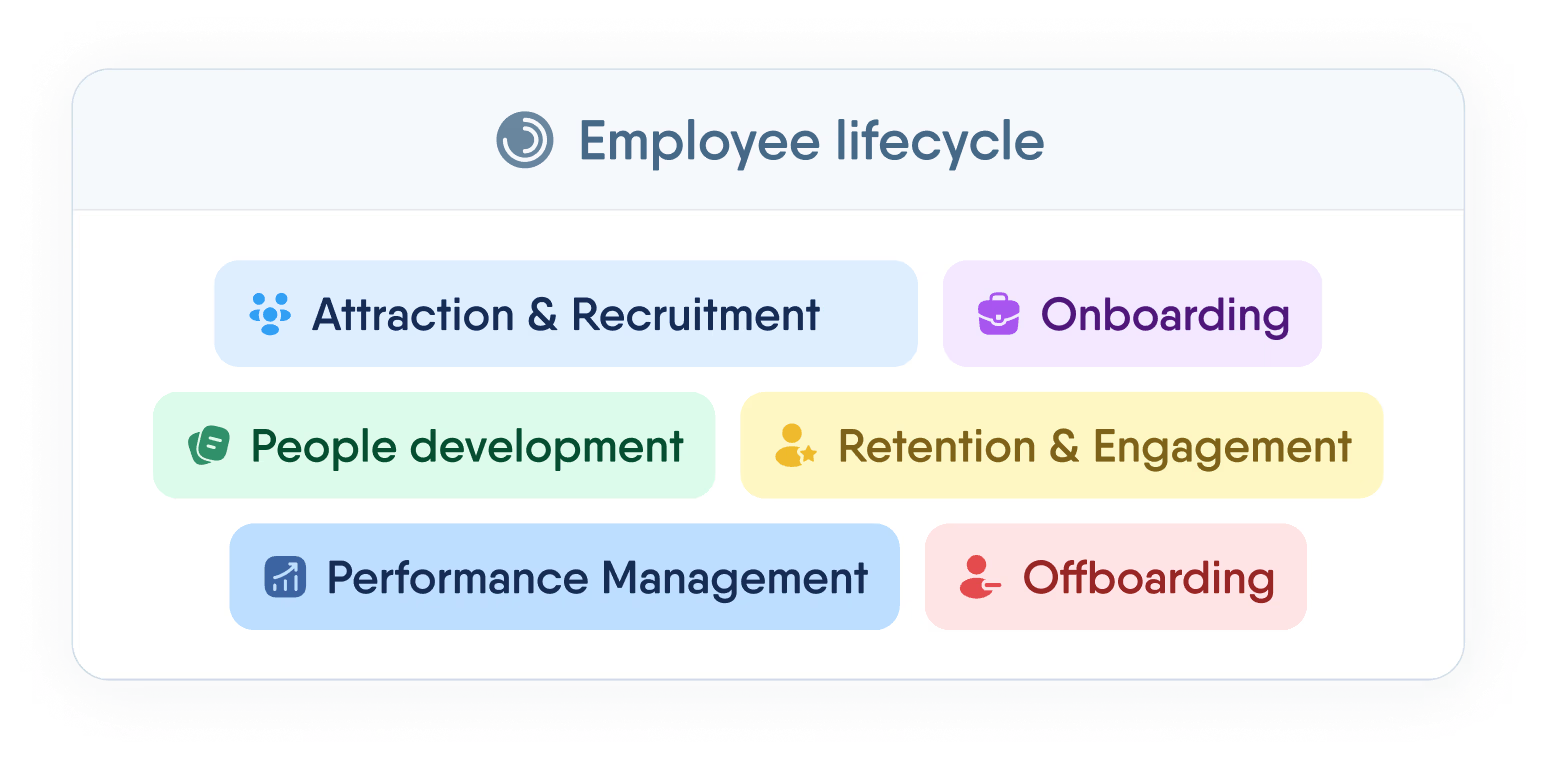
Manage the full employee lifecycle — from first interview to final offboarding — without switching tabs or losing data.
Recent articles
 2026-11-05
Gamification in HR: what it is and how to use it in training and sales
What gamification is, which game mechanics it uses, examples in HR, training and sales, and how to introduce it without putting the team off.
2026-11-03Inclusion in the workplace: what it means and how to build an inclusive culture
What workplace inclusion is, why it drives retention, engagement and innovation, and the practical steps that help build an inclusive culture.
2026-11-02AI in HR: the five jobs it does today, and how each one looks in PeopleForce
Most AI in HR today falls into five jobs. How each one works, how it looks in PeopleForce, and the five questions to ask any vendor.