
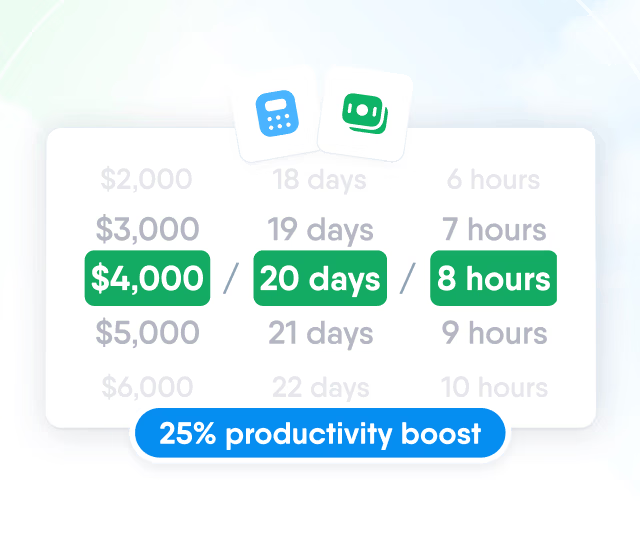
HR efficiency estimator
How does the HR efficiency estimator from PeopleForce work.
Calculate your impact



People management
The everyday work of leading a team: setting direction, giving feedback, developing people and handling the conversations nobody enjoys.
People management is the everyday practice of leading a team: setting direction, distributing work, giving feedback, developing individuals and handling problems between them. It sits with whoever has direct reports, not with the HR department. HR designs the frameworks and tools; people management is what happens inside them, week after week, in one-to-one conversations that nobody else sees.
People management, HR management and people operations
The three are often used interchangeably and should not be. HR management is a function: policies, compliance, compensation structures, hiring processes. People operations is a way of running that function, treating employees as internal customers and measuring outcomes rather than activity. People management is the manager's craft, and it is where company policy either becomes real or quietly falls apart. A generous parental leave policy means little if the manager treats a returning parent as a problem to schedule around.
What it covers in practice
- Direction. Translating company goals into work the team understands, and saying no to what does not fit.
- Regular conversation. The one-on-one meeting is the main instrument here, and it works only when it is protected rather than cancelled whenever the week gets busy.
- Feedback. Specific, timely and two-way, which is what turns an annual performance review into a summary of things already discussed instead of an ambush.
- Development. Helping people grow in a direction that fits both them and the business, which is where career growth stops being an abstract promise.
- Recognition. Making good work visible through rewards and recognition rather than assuming people know.
- Difficult situations. Underperformance, conflict, burnout signals and resignations, handled early rather than when they become formal cases.
The skills that separate good from adequate
Most managers are promoted for individual results and then asked to do a different job. The transition depends on a few learnable skills: listening without immediately solving, delegating outcomes instead of tasks, adapting to the person in front of you rather than applying one of the management styles universally, and holding standards without micromanagement. The last one is the hardest, because the instinct that made someone a strong specialist is exactly the instinct to take the work back.
How to tell whether it works
People management is often assessed on how a manager appears rather than on what happens in their team. More honest signals sit in the data: retention and employee turnover by team rather than company-wide, employee engagement scores compared across managers, internal moves out of the team as a positive rather than a loss, and whether people raise problems early or only at the exit interview.
How PeopleForce supports managers
PeoplePerform gives managers the structure for the regular work: goals, one-to-one agendas, continuous feedback and review cycles that open on schedule instead of being chased. PeoplePulse adds the signal managers rarely get unprompted through engagement and pulse surveys, which can be run anonymously so the answers are usable. And because team structure, absences and job history live in PeopleHR, a manager can see their team's real context without asking HR for an export.


Let us show you what's possible
From Core HR to advanced workforce analytics — see the platform saving 80 hours a month for teams just like yours. Fully tailored to your workflow.