
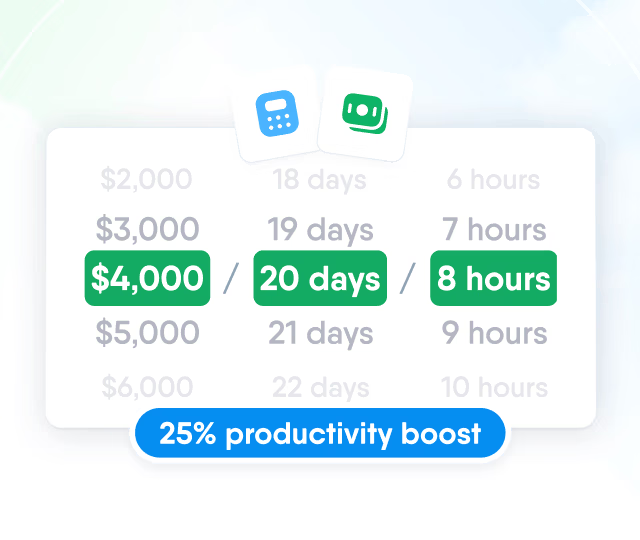
HR efficiency estimator
How does the HR efficiency estimator from PeopleForce work.
Calculate your impact



Parental leave
Parental leave is job-protected time off for parents to care for a newborn or newly adopted child. It includes maternity, paternity and shared parental leave, and may be paid, partly paid or unpaid depending on the country.
Parental leave is a period of job-protected absence granted to employees who become parents, whether through birth, adoption or foster placement, so they can care for the child. It is an umbrella term: in most legal systems it covers maternity leave for the mother around childbirth, paternity leave for the father or second parent, and a further period of parental or childcare leave that either parent can take, sometimes shared between them. Unlike a leave of absence granted at the employer's discretion, parental leave is a statutory right almost everywhere, and the employee returns to the same or an equivalent job when it ends.
Maternity, paternity and parental leave: the differences
Maternity leave protects the health of the mother and child and usually starts shortly before the due date; part of it is often compulsory. Paternity leave is a shorter block, typically from two days to several weeks, taken by the other parent around the birth. Parental leave proper is the longer, more flexible period that follows: it can often be taken in blocks, part-time or by either parent until the child reaches a certain age. Many countries pay these leaves at different rates. Maternity and paternity leave tend to be paid at or near full salary by the state or the employer, while the extended parental period is paid at a flat rate, a percentage of salary or not at all, which is where it overlaps with unpaid leave.
How parental leave works around the world
Entitlements vary more than for almost any other type of leave:
- Ukraine: maternity leave of 126 calendar days (70 before and 56 after the birth, extended to 70 after for complicated births or twins), paid by the social insurance fund; fathers or other family members can take up to 14 calendar days of paid leave at the birth of a child; either parent can then take childcare leave until the child turns three, with the position protected but no salary.
- Poland: 20 weeks of maternity leave (more for multiple births), 2 weeks of paternity leave to be used before the child turns 12 months, and 41 weeks of parental leave (43 for multiples), of which 9 weeks are reserved for each parent and cannot be transferred; benefits are paid by ZUS at 100 %, 70 % or an averaged 81.5 % depending on the option chosen.
- Argentina: 90 days of maternity leave (usually 45 before and 45 after the birth) paid through the family allowance system, a statutory 2 days of paternity leave under the Labour Contract Law, often extended by collective agreements, and the option of an unpaid excedencia of three to six months after maternity leave.
- United States: no federal paid leave; the FMLA gives eligible employees 12 weeks of unpaid, job-protected leave, and a growing number of states run paid family leave programs.
- European Union: the Work-Life Balance Directive sets a floor of 10 working days of paternity leave and 4 months of parental leave per parent, of which 2 months are non-transferable and must be paid.
These rules change frequently, so HR should confirm the current labor law position for each country before advising an employee.
Pay, benefits and job protection during leave
Who pays, and how much, is the central question. In most of Europe and Latin America the state social insurance system funds the benefit, and the employer either advances it and is reimbursed or simply stops paying salary. Employers may top up statutory pay to full salary as part of their employee benefits, which is a strong retention lever. Beyond pay, the policy must state whether holiday accrual continues (in many countries it does during paid leave), whether bonuses and salary reviews are prorated, and how health insurance is maintained. Dismissal during pregnancy and parental leave is prohibited or heavily restricted in most jurisdictions, and returning parents are commonly entitled to request flexible working hours or breastfeeding breaks.
Managing parental leave well: an HR checklist
Plan the handover early: agree with the employee and their manager which responsibilities move where and whether a temporary replacement or internal rotation is needed. Set up the documents: leave application, medical certificate or birth certificate, and the statutory notifications to the social insurance authority, each with its deadline. Keep the employee informed but not obliged during leave, for example with an opt-in company newsletter. Prepare the return: a short re-onboarding, updated access and equipment, and a conversation about schedule and workload in the first weeks. Finally, treat fathers' and second parents' leave as normal, not exceptional; uptake by all parents is one of the clearest signals of an inclusive company culture.
Parental leave in PeopleForce
PeopleForce leave tracking lets you configure maternity, paternity and childcare leave as separate leave types, each with its own duration rules, paid or unpaid status, approval flow and required documents, and assign different policies to entities in different countries. Long absences are visible in the team calendar and on the employee profile, so managers and colleagues know who is away and until when. The related paperwork, from applications to birth certificates, is stored in the employee's document folder and can be signed through electronic signature, while workflows automate the handover and return-to-work tasks so nothing depends on someone remembering the date.


Let us show you what's possible
From Core HR to advanced workforce analytics — see the platform saving 80 hours a month for teams just like yours. Fully tailored to your workflow.