
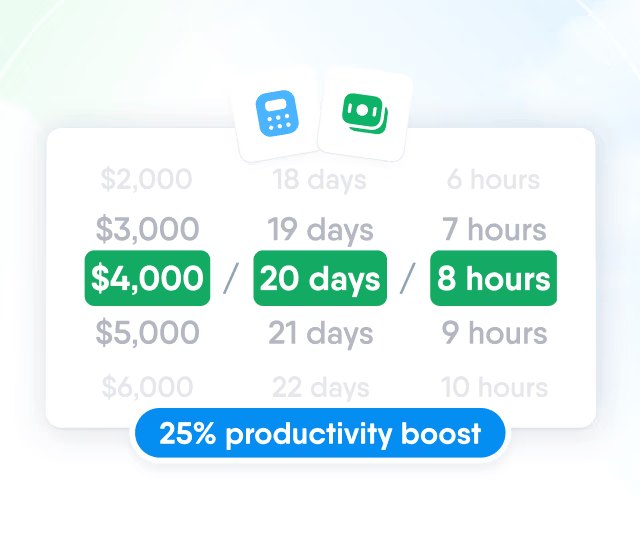
HR efficiency estimator
How does the HR efficiency estimator from PeopleForce work.
Calculate your impact



HR generalist
The role that covers the whole HR function instead of one slice of it. What it includes, how it differs from a specialist, and when a company outgrows it.
An HR generalist is the person who covers the whole HR function rather than one part of it: hiring, onboarding, personnel records, policies, employee questions, performance cycles and exits. In a company of roughly 30 to 300 people, the generalist usually is the HR department. Breadth is what makes the role valuable and also what limits it.
What an HR generalist does
The scope is the full employee life cycle, run end to end by one person or a very small team:
- Recruiting: opening vacancies, screening, coordinating interviews with the hiring manager, preparing offers.
- Onboarding and offboarding: contracts, first day setup, equipment, exit interviews.
- Personnel administration: employment documents, leave balances, absence records, and the data accuracy that payroll depends on.
- Policies and HR compliance: keeping the handbook current and making sure daily practice matches what it says.
- Employee relations: answering questions, mediating conflicts, handling grievances before they escalate.
- Running the performance review cycle, engagement surveys and training requests.
Generalist, specialist, business partner
An HR specialist owns one domain deeply, such as compensation, talent acquisition or learning, and gets hired when the volume in that domain justifies a dedicated person. The generalist owns everything at the depth needed to keep it running. An HR business partner sits on a different axis: similar breadth, but the job is advising a business unit's leadership on structure, capability and people decisions rather than executing the administration behind them.
The typical sequence is one generalist first, then the first specialist in whichever area consumes most of the week, then business partners once the company is large enough that leadership teams need dedicated advice. A chief people officer appears later still, when people strategy needs a voice at board level.
When one generalist is no longer enough
The signals are consistent across companies. Most of the week goes to repeat questions and chasing documents rather than to anything that compounds. Recruiting stalls because the same person who screens candidates also has to close payroll that week. Policy work gets postponed for months. Managers start solving people problems on their own, which is how inconsistent practice enters the company.
The fix is rarely a second generalist. It is usually taking the highest volume block out of the role, most often recruiting or personnel administration, and automating the repetitive part of what remains. A clear map of HR processes shows which block that is faster than any headcount debate.
Skills and background
The role rewards prioritisation more than specialist expertise: at any moment there are more open items than hours, and the skill is knowing which three matter. Beyond that, working knowledge of local labour law, documentation discipline, discretion with sensitive information, and comfort with running things in a system rather than in spreadsheets. Certifications such as CIPD or SHRM help with credibility and structure, but most generalists arrive through a mix of recruiting and administration experience rather than through a single path.
How PeopleForce keeps the role workable
A generalist role breaks when the same work is repeated by hand. Core HR holds one employee record that documents, leave and reporting all read from, so nothing has to be reconciled between files. Repetitive employee requests go through request forms with their own approval chains, and workflows trigger the tasks that follow an event such as a hire, a transfer or a departure.
The question flow, which is what usually consumes a generalist's day, moves into PeopleDesk: employee questions become tracked cases with an owner and a comment history, and the answers that repeat live in a knowledge base instead of being retyped. Access is set per module through granular role permissions, so a manager sees only their own team and sensitive fields such as salary stay restricted even for people who otherwise work inside the system.


Let us show you what's possible
From Core HR to advanced workforce analytics — see the platform saving 80 hours a month for teams just like yours. Fully tailored to your workflow.